Hyundai Ioniq 9 first drive: the seven-seat electric SUV done properly
Spacious, comfortable and seriously efficient, Hyundai's biggest EV yet aims squarely at the family market. After driving it in the UK, we explain who it suits and where rivals still have an edge.
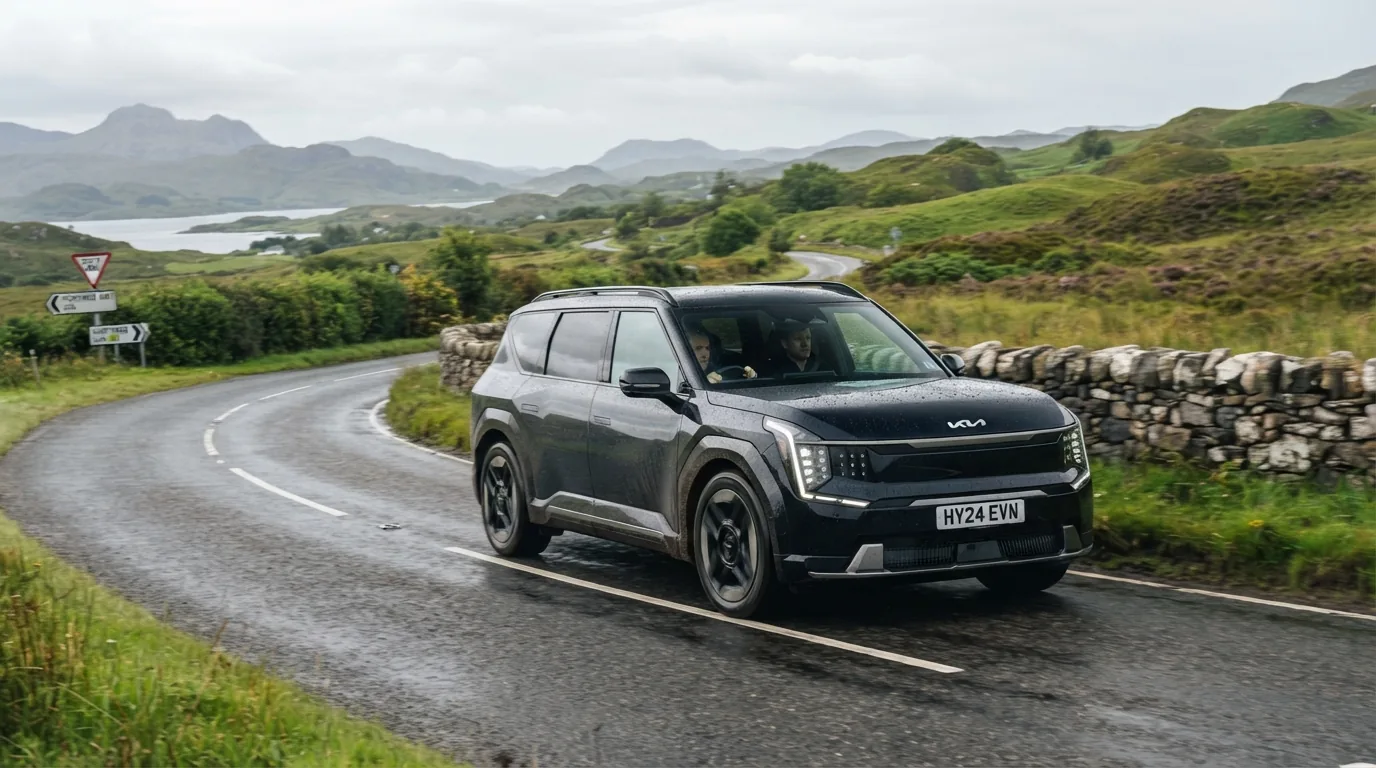
Quick answers
- The Ioniq 9 starts from £64,995, undercuts the Volvo EX90 by over £15,000, and is fractionally cheaper than the Kia EV9 at approximately £65,995.
- Its 385-mile WLTP range on the RWD drops to around 275-300 miles on a UK motorway run, which is still the best in its class for a seven-seat electric SUV.
- The 800V system charges from 10 to 80% in 24 minutes on a suitable rapid charger, putting it among the fastest-charging family cars available.
- Third-row legroom of 813 mm means adults can genuinely use it, and Isofix points in row three are rare in this class (figures vary, verify current data).
- Parkers named it Best Seven-Seater for 2026; Euro NCAP gave it five stars with 84% adult occupant protection and 87% child occupant protection.
- The infotainment menu structure is its one notable weak point; the ownership package including the 5-year unlimited-mileage warranty, low BIK rate for company car drivers, and standard V2L capability otherwise makes a strong case.
Hyundai Ioniq 9 review: the seven-seat electric SUV that finally gets it right
The Hyundai Ioniq 9 starts from £64,995, seats seven adults in genuine comfort, and charges from 10 to 80% in 24 minutes. In a segment where compromises are the norm, that combination is hard to argue with. Parkers named it Best Seven-Seater at their 2026 New Car Awards, and after spending time with it on UK roads, we think the recognition is well-earned.
Context helps here. The Ioniq 9 enters a market where the realistic competition can be counted on one hand. The Kia EV9 shares its 800V platform and sits at a similar price; the Volvo EX90 is considerably more expensive; the VW ID.Buzz offers something different in character. Against all of them, the Ioniq 9 makes a coherent argument based on range, third-row practicality, and ownership cost. It carries a 110 kWh battery, a claimed range of 385 miles WLTP on the rear-wheel-drive version, and real-world figures that, while lower, are still the best in its class.
This review works through every angle that matters for families considering a large electric SUV: trim choices, third-row reality, real-world range, charging, driving feel, technology, running costs, and how it stacks up against the alternatives.
What the Ioniq 9 is, and who it is for
At 5,060 mm long, 1,980 mm wide and 1,790 mm tall, the Ioniq 9 is a large car by any measure. It is Hyundai’s flagship EV and sits above the Ioniq 6 saloon and Ioniq 5 crossover in the range. Three trim levels cover the UK lineup, with a choice of rear-wheel drive or all-wheel drive depending on the variant.
| Trim | Powertrain | Price | WLTP Range |
|---|---|---|---|
| Premium | 218PS RWD | £64,995 | 385 miles |
| Ultimate | 307PS AWD | £73,495 | 376 miles |
| Calligraphy | 307PS AWD | £75,795 | 372 miles |
Every trim includes seven seats as standard, though the Calligraphy is also available as a six-seat configuration with captain’s chairs in the second row, which include a massaging function. Buyers who want maximum performance can specify the Calligraphy with the 427PS all-wheel-drive Performance powertrain, which dispatches 0-62 mph in 5.2 seconds.
A 0.27Cd drag coefficient is notably low for a vehicle this size, and it contributes directly to the efficiency figures. A heat pump is standard across all trims, as is vehicle-to-load (V2L) capability. Neither feature requires an upgrade, which is the right decision for a family vehicle competing on value.
The buyer profile here is fairly clear: large families who need three genuine rows, company car drivers attracted by the lowest BIK band for zero-emission cars (figures vary, verify current data at HMRC.gov.uk), and households doing regular long-distance runs who want to stop as infrequently as possible. The premium price keeps it out of reach of the budget-conscious, but within its target market it makes a strong case.
Third-row space: can adults actually sit in it?
This is the question that matters most for a seven-seater, and it is the one where the Ioniq 9 most clearly pulls ahead of the competition. The third row offers 813 mm of legroom and 1,008 mm of headroom (figures vary, verify current data against Hyundai’s official technical documentation). Those numbers are not merely competitive, they are genuinely unusual for a car of this type.
Average-height adults can sit in the third row for a reasonable journey without the knees-to-chin posture that plagues many rival seven-seaters. This is not a claim every large SUV can make. The second row slides and tilts to ease access, so getting in and out is not the obstacle course it can be on some vehicles.
There is one additional detail that stands out for parents: the Ioniq 9 has Isofix mounting points in the third row. This is rare in the class, and it means families can fit child seats across all three rows if needed, rather than having to choose.
Boot space with all seven seats in use is 338 litres. Fold the third row and that rises to 908 litres. Drop all rear seats and you have 2,419 litres of load space. The front boot adds capacity, though there is a practical difference depending on which variant you buy: RWD models get 88 litres under the bonnet, while AWD models have a smaller 52-litre frunk due to the front motor.
How does the boot compare against the nearest rivals? (Figures vary, verify current data against each manufacturer’s specifications.)
- Kia EV9 boot (7-seat): 333 litres
- Peugeot E-5008 (7-seat): 348 litres
- VW ID.Buzz LWB (7-seat): 306 litres
The Ioniq 9 does not win every comparison by a large margin, but it is consistently towards the top of the class. Parkers, in their 2026 award citation, described it as “surpassing last year’s winner, the Kia EV9, thanks to its more practical and useful interior packaging.” That is a measured endorsement from a source that has tested both cars extensively.
If you want the widest possible view of seven-seat family options, our full guide to the best electric cars for families covers every size and budget.
Real-world range: what to expect on a UK motorway
The 385-mile WLTP figure for the RWD Premium is the headline number, and it is genuinely impressive. But WLTP testing conditions do not replicate a loaded family car travelling at 70 mph on the M1 in November, so the honest picture is rather different.
In real-world motorway testing by UK reviewers, the AWD test cars achieved approximately 2.5 mi/kWh, which translates to around 275 miles of usable range at motorway speeds. In mixed driving combining urban and motorway routes, 300 miles or more was regularly achievable. Parkers recorded 3.0-3.1 mi/kWh in mixed conditions. Auto Express put the figure at approximately 287 miles in their testing, which appears to reflect a motorway-weighted route.
The RWD Premium is the more efficient of the three trims, and if range is your priority, it is the variant to choose. The AWD models trade a small amount of range for additional performance, though the gap between 385 miles (RWD) and 372 miles (AWD Calligraphy) is narrow enough to be largely irrelevant in day-to-day use.
WLTP vs real-world range at a glance:
| Condition | Estimated range |
|---|---|
| WLTP (RWD) | 385 miles |
| WLTP (AWD) | 372-376 miles |
| UK motorway (AWD, reviewer testing) | ~275 miles |
| Mixed driving (UK reviewers) | 300+ miles |
A few factors limit cold-weather performance on any EV, and the Ioniq 9 is no exception. The heat pump, standard on all trims, recovers some efficiency in low temperatures, but winter range will still be lower than the figures above. Plan charging stops more conservatively on cold days, particularly on motorway runs with a full passenger load.
The 110.3 kWh battery and 0.27Cd drag coefficient both help sustain efficiency at speed, and the combination makes the Ioniq 9 the best-range option in its class by a meaningful margin over the Kia EV9 (349 miles WLTP, figures vary, verify current data).
Charging: 24 minutes from 10 to 80% in practice
An 800V battery architecture is a specification detail that translates into something very tangible on a long motorway trip. The Ioniq 9 supports peak DC charging of 233 kW, and on a suitably powerful rapid charger, the 10-80% charge completes in 24 minutes. That 24-minute figure puts it among the fastest rapid-charging EVs on sale today.
To put that in context: a family stop at a motorway services for a coffee and a bathroom break will overlap comfortably with the time the car needs to charge. You will not be waiting for the car; the car will likely be waiting for you.
Here is what different charger types mean in practice:
| Charger type | Maximum power | 10-80% time |
|---|---|---|
| 350 kW ultra-rapid DC | 233 kW peak | 24 minutes |
| 50 kW public rapid DC | 50 kW | ~94 minutes |
| 11 kW home AC wallbox | 11 kW | ~10-11 hours |
| 7 kW home wallbox | 7 kW | ~17 hours |
The 11 kW home charging figure is particularly relevant for daily use. An overnight charge from near-empty to full takes around 10-11 hours, which fits inside a normal sleep cycle. Arrive home with 20% remaining, plug in, wake up to a full battery.
The Ioniq 9 uses the CCS charging standard, which covers the entire UK and European rapid charging network. There is no compatibility constraint to worry about beyond ensuring the charger is rated appropriately for the speed you want.
One technical advantage of the 800V system is that it sustains peak charging rates for longer with less heat build-up compared with lower-voltage architectures (medium confidence, based on available reviewer data). What is clear in practice is that the Ioniq 9 makes rapid charging feel straightforward rather than stressful, which is exactly what a family car needs to do.
How it drives: refined but not sporty
Expectations matter here. The Ioniq 9 is not trying to be a driver’s car, and it would be doing you a disservice to pretend otherwise. It is a large, heavy, long-distance family carrier, tuned accordingly.
The RWD 218PS version takes 9.4 seconds to reach 62 mph. That is adequate for a car of this type, not quick. Step up to the AWD 307PS and 0-62 mph drops to 6.7 seconds, which feels meaningfully brisk in day-to-day driving. The Performance AWD at 427PS and 5.2 seconds is quick by any standard, though it makes least sense for the vehicle’s actual character.
UK reviewers consistently describe the driving experience in terms of refinement rather than engagement. “Calm and quiet” appears repeatedly. Autocar’s verdict was that it “majors on practicality and long-distance refinement,” which is exactly the right frame for this car. The RAC Drive awarded it 8/10 for ride and handling, which is excellent for the class and reflects how well the suspension tuning manages the car’s considerable mass.
Handling is capable without being interesting. The Ioniq 9 does not embarrass itself when asked to change direction, but this is not a vehicle that rewards an enthusiastic approach to corners. It is, however, a vehicle you will look forward to driving from Edinburgh to London with three children in the back and luggage to match. That is the relevant metric here.
The safety record backs up the composed character. Euro NCAP tested the Ioniq 9 in 2025 and awarded it five stars: 84% adult occupant protection, 87% child occupant, 77% vulnerable road users, 83% safety assist. The child occupant score in particular is relevant for the car’s target market.
Technology and infotainment: mostly excellent, one frustration
The technology specification is thorough without being wasteful. All three trims get dual 12-inch screens, one for the instrument cluster and one for the central touchscreen. The Hyundai AI Assistant, accessed via Bluelink Plus, is included free for three years. Over-the-air software updates mean the car can receive new features without a dealer visit, and the Features on Demand digital upgrade store allows owners to unlock additional functionality post-purchase.
V2L deserves particular attention for families who camp or spend time at outdoor events. The Ioniq 9 provides an internal 230V three-pin socket with up to 3.6 kW output, standard on all trims. You can run a kettle, charge laptops, or power a portable fridge directly from the car’s battery. A camping mode keeps the climate control running while the vehicle is stationary without triggering unnecessary system alerts. These are practical features for the way the car is likely to be used, not marketing bullets.
The Calligraphy six-seat variant adds second-row seats that can swivel to face the third row, creating a lounge-style layout when parked. For long stops on a road trip, this is genuinely useful.
Technology at a glance:
Strengths:
- Dual 12-inch screens standard across all trims
- Over-the-air updates and Features on Demand upgrades
- V2L (3.6 kW, 230V three-pin) and camping mode standard on every trim
- Bluelink Plus AI assistant, three years free
- 83% Euro NCAP safety assist score
Weakness:
- Infotainment menu structure is overly nested and takes time to learn
That infotainment point is worth naming clearly because it comes up consistently across UK reviews. This is not a defect, and most owners report adapting to the layout within a few weeks. But if you come from a car with straightforward menus, the Ioniq 9 will require some patience early on. It is a learning curve, not a reason to reconsider the car.
Running costs and ownership: the numbers that matter
The headline ownership number for most private buyers is the VED position. The Ioniq 9’s list price above £40,000 means the luxury car supplement applies from the second year of ownership. The exact current annual figure must be verified at GOV.UK’s vehicle tax rate tables before purchase, as these rates are revised annually (figures vary, verify current data at gov.uk/vehicle-tax-rate-tables).
For company car drivers, the picture is considerably more attractive. Zero-emission cars currently attract the lowest BIK band at 2% for the 2026/27 tax year (figures vary, verify current data at gov.uk/guidance/tax-on-company-cars before calculating your position). On a £73,495 Ultimate, that 2% rate represents a substantial saving against an equivalent diesel or petrol car in the same price bracket.
Key ownership figures:
- Warranty: 5-year, unlimited-mileage vehicle warranty. Battery warranty: 8 years or 100,000 miles.
- Insurance: Groups 42-49 depending on trim (verify at time of quoting).
- Home charging: On an off-peak overnight tariff at around 7p/kWh, a full 110 kWh charge costs approximately £7.70 (figures vary, verify current energy tariff rates, as these change frequently).
- Personal leasing: From approximately £644 per month on personal contract hire, though lease prices shift constantly. Our regularly updated guide to best EV lease deals tracks the current market.
- Service plan: A 5-year Hyundai service plan is available; confirm pricing and scope with your dealer.
The 5-year warranty with no mileage cap is a material advantage for high-mileage users. Many large EVs carry mileage-limited warranties. The Ioniq 9’s unlimited cover removes that concern entirely.
One note on promotional pricing: Hyundai previously offered a £1,500 deposit contribution on all Ioniq 9 models, reported as running until March 2026. This has likely expired at time of publication. Check current offers at Hyundai’s UK site before assuming any contribution applies to your purchase.
How it compares: Ioniq 9 vs the seven-seat EV field
No seven-seat EV buying decision should be made without looking at the alternatives. Here is the current UK competitive picture. (All prices and specifications should be verified at the time of purchase, as they change.)
| Car | Price from | WLTP range | Boot (7-seat) | Real-world mi/kWh |
|---|---|---|---|---|
| Hyundai Ioniq 9 RWD | £64,995 | 385 miles | 338 litres | ~3.0-3.1 (mixed) |
| Kia EV9 | ~£65,995 | 349 miles | 333 litres | Comparable |
| Volvo EX90 | ~£82,000+ | 374 miles | Not stated | Comparable |
| VW ID.Buzz LWB | ~£60,000+ | ~262 miles | 306 litres | Lower |
| Peugeot E-5008 | Under £50,000 | Up to 395 miles | 348 litres | Varies |
Kia EV9: The closest match in almost every respect. The EV9 shares the same 800V Hyundai Motor Group platform and similar dimensions. It costs fractionally more from around £65,995, and its WLTP range trails the Ioniq 9 at 349 miles (figures vary, verify current data). Reviewers generally consider the EV9 to have slightly sportier handling. The Ioniq 9 took the Parkers 2026 Best Seven-Seater award on the strength of its interior packaging. If you prefer the Kia’s styling, it is a credible alternative rather than a compromise.
Volvo EX90: Premium Scandinavian positioning at a significantly higher entry price. The gap between the two cars is over £15,000 at base price, and the EX90’s 374-mile WLTP range does not justify that premium on pure specification grounds. If the Volvo interior design and brand positioning matter to you, the price may be worth it; on objective metrics, the Ioniq 9 represents better value.
VW ID.Buzz LWB: A different proposition entirely. The ID.Buzz wins on ease of third-row access, and its character is distinctly more lifestyle-oriented than the Ioniq 9’s family hauler positioning. The shorter WLTP range of around 262 miles is a real constraint for long-distance families. It is the choice if access ease and character matter more than range.
Peugeot E-5008: The most affordable seven-seat EV in the UK market. A WLTP range of up to 395 miles is competitive on paper, but the third row is less accommodating for adults than the Ioniq 9’s. If budget is the primary concern it deserves a test drive, but the Ioniq 9 is the more complete package for most buyers with seven-seat requirements.
The Ioniq 9’s position is clear: best all-round combination of range, third-row space, and price in the class. The only cars that beat it are the VW ID.Buzz on ease of third-row access and the Peugeot E-5008 on purchase price.
Our verdict
For most buyers, the Premium RWD at £64,995 is the right choice. It delivers the longest WLTP range of the three trims at 385 miles, the largest front boot at 88 litres, and the third-row space is identical across all variants. You are not sacrificing practicality by avoiding the AWD upgrade.
The AWD trims make sense if you regularly need to carry seven people on long motorway runs where additional performance matters, or if you want all-wheel drive for winter confidence. The range penalty between RWD and AWD is modest, at 385 miles versus 372 miles, so it need not be a deciding factor.
The Calligraphy six-seat variant with Performance AWD is the most indulgent specification and hard to justify on purely rational grounds. The swivelling second-row seats are genuinely useful; the rest of the upgrade is largely about feel.
Two weaknesses are worth naming before you sign anything. The infotainment menu structure takes time to master, and the list price above £40,000 triggers the luxury VED supplement from year two (verify current rate at GOV.UK). Neither is a reason to walk away, but both should be factored in.
The awards tell their own story: Parkers Best Seven-Seater 2026, Top Gear Electric Award 2025, and five-star Euro NCAP. The Ioniq 9 earned all three.
Ready to compare the Ioniq 9 against the full range of electric options? See all our electric car reviews and comparisons to find the right EV for your needs and budget.
How we test and where our numbers come from
Range figures are official WLTP combined values taken from manufacturer UK specification pages, with real-world estimates drawn from independent comparative testing. Prices are UK list prices at the time of the latest update. Tax, grant and charging-scheme figures come from GOV.UK and HMRC publications. We re-check every guide when pricing, specification or policy changes. Last checked 11 August 2026.
Frequently asked questions
Third-row space: can adults actually sit in it?
This is the question that matters most for a seven-seater, and it is the one where the Ioniq 9 most clearly pulls ahead of the competition. The third row offers 813 mm of legroom and 1,008 mm of headroom (figures vary, verify current data against Hyundai's official technical documentation).
Sources and further reading
- euroncap.comEuro NCAP Hyundai Ioniq 9 resultsFull breakdown of all safety test scores referenced in this article
- hyundai.newsHyundai Motor UK Ioniq 9 pricing and spec press releasePrimary source for all pricing, trim, powertrain and technology specifications
- rac.co.ukRAC best electric seven-seaters guideAuthoritative UK comparison context covering all major rivals in the class

EV Compared
The EV Compared editorial team tracks the UK electric vehicle market full time: new model launches, list prices, WLTP and real-world range, public charging tariffs and the tax rules that decide what an EV actually costs to run. Every guide is checked against manufacturer specifications and official GOV.UK figures, and updated whenever the numbers move.
Related reading
View all
Renault 5 E-Tech undercuts rivals with sub-£23,000 UK launch price
Renault's reborn supermini lands in Britain cheaper than expected, putting real pressure on a market crowded with pricier rivals. We break down the trims, range, and who it is really for.
Volkswagen ID.2 prototype driven: the £22k people's EV takes shape
Our first time behind the wheel of VW's long-promised affordable electric hatchback ahead of its 2026 showroom debut. Range, pricing, specs and what it is really like to drive.