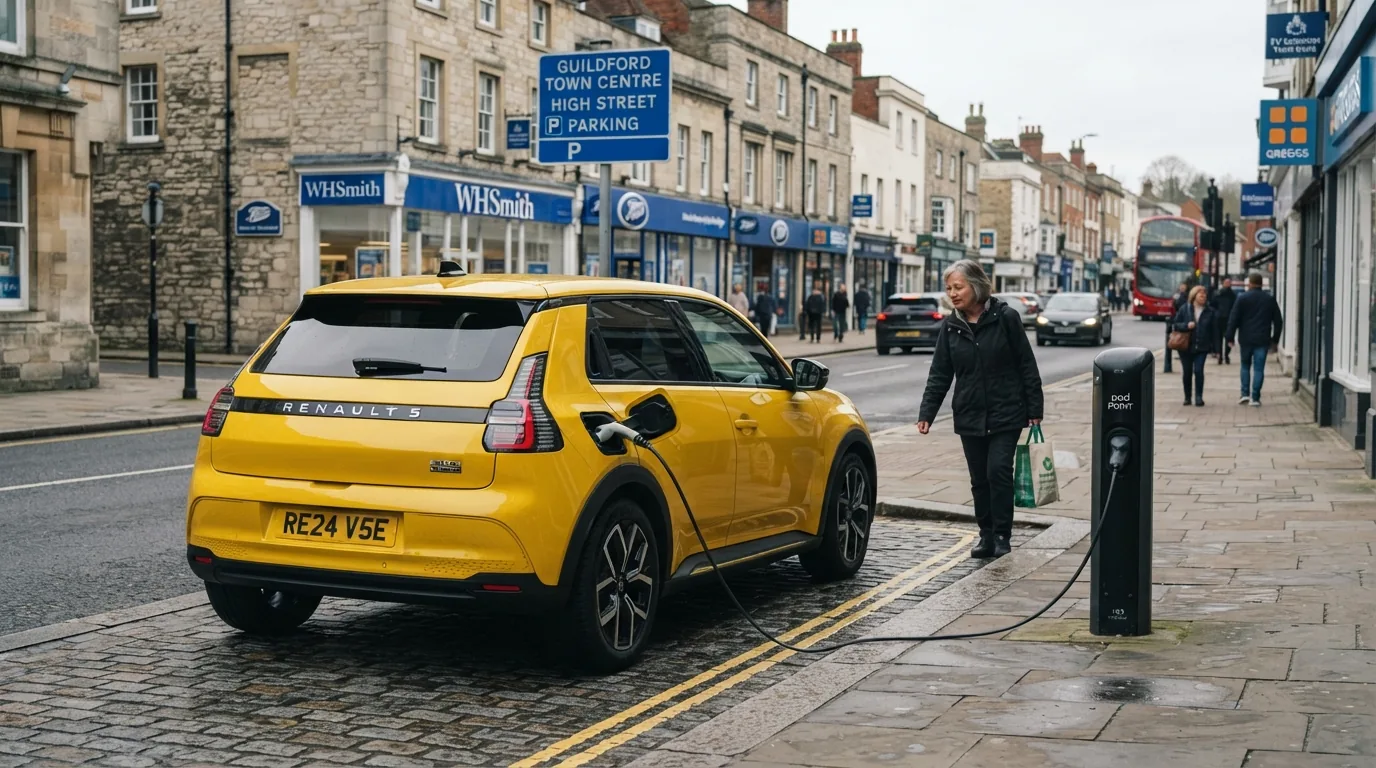
Renault 5 E-Tech undercuts rivals with sub-£23,000 UK launch price
Renault's reborn supermini lands in Britain cheaper than expected, putting real pressure on a market crowded with pricier rivals. We break down the trims, range, and who it is really for.
Quick answers
- The Renault 5 E-Tech starts at £22,995 OTR in Evolution trim with the 40kWh battery, dropping to £21,495 after the £1,500 Electric Car Grant.
- Upgrading to the 52kWh Techno+ unlocks the full £3,750 government grant, bringing the net price to approximately £23,495, because the larger battery is built at Renault's Douai gigafactory and meets the scheme's sustainability criteria.
- Real-world range is approximately 140-150 miles for the 40kWh on a mixed route, and 190-210 miles for the 52kWh; both are well below WLTP figures of 193 miles and 250 miles respectively.
- Rapid charging from 10% to 80% takes approximately 30-35 minutes on both variants; V2L power export is available, which is uncommon at this price point.
- Company car BIK is 4% in 2026/27, making the R5 one of the most tax-efficient small cars available for fleet and business drivers.
- Euro NCAP: 4 stars, with the shortfall on active safety rather than crash structure; Green NCAP: 5 stars for sustainability.
Renault 5 E-Tech UK price and value guide: what you get, what the grant covers, and how it compares
The Renault 5 E-Tech starts at £22,995 on the road in Evolution trim, dropping to £21,495 once you factor in the £1,500 Electric Car Grant it attracts. Move up to the 52kWh Techno+ and you qualify for the full £3,750 grant, bringing that model to approximately £23,495 after subsidy. Two batteries, two different grant bands, and a price gap that makes the trim choice more interesting than it first appears.
If you are weighing up the small electric cars currently on sale in the UK, the Renault 5 E-Tech has moved to the top of most shortlists. The MINI Cooper Electric costs more for less boot space. The Peugeot e-208 is pricier at comparable spec. The Kia EV2 starts higher. And with battery costs falling below $100/kWh at pack level, the timing of the R5’s arrival is not accidental: mainstream affordable EVs are only now becoming genuinely viable for Renault to build and sell at this price point. Named What Car? Car of the Year 2025, European Car of the Year 2025, and UK Car of the Year 2026, this is a car that has arrived with the industry’s attention. Here is what it actually costs, what it does, and whether it is right for you.
Renault 5 E-Tech prices: every trim level and what it costs after the grant
The grant structure is the first thing to get your head around, because it directly determines whether you pay £21,495 or £23,495 for your entry point into the range.
The Electric Car Grant operates in two bands. Band 1 pays £3,750 off eligible models; Band 2 pays £1,500. Which band a car falls into depends on whether its battery meets the scheme’s sustainability and supply-chain criteria. For the Renault 5, the 52kWh battery packs qualify and the 40kWh battery does not. Specifically, the 52kWh pack is built at Renault’s Douai gigafactory in France, meeting the threshold. The 40kWh battery is sourced externally and attracts only the smaller £1,500 subsidy. You do not need to fill in a form or claim anything separately: the grant is applied automatically by the dealer at point of sale. It runs until summer 2027.
Here is the full picture across the four live trim levels:
| Trim | Battery | OTR price | Grant | Price after grant | Notes |
|---|---|---|---|---|---|
| Evolution | 40kWh | £22,995 | £1,500 (Band 2) | £21,495 | Entry model; well equipped |
| Techno+ | 52kWh | ~£26,745 | £3,750 (Band 1) | ~£23,495 | Best value upgrade path |
| Iconic Five+ | 52kWh | £28,995 | £3,750 (Band 1) | ~£25,245 | Adds luxury kit |
| Roland Garros+ | 52kWh | £29,995 | £3,750 (Band 1) | ~£26,245 | Top-spec tennis edition |
To put it plainly: Band 1 gives you a larger subsidy because the battery meets the scheme’s sustainability criteria, and the manufacturer has to demonstrate this to OZEV. For buyers, the practical takeaway is that spending roughly £4,000 more on the Techno+ OTR actually costs you only around £2,000 more out of pocket once both grants are applied, because the larger grant closes most of the gap.
Figures vary for the exact Techno+ OTR price listed above: verify the current configurator price on the Renault UK website before finalising any decision.
How the Renault 5 E-Tech price compares to its main rivals
Knowing the R5’s grant-adjusted price matters most when you line it up against the competition. A headline OTR figure can be misleading when different cars attract different subsidies or none at all.
| Car | Entry OTR | After grant (approx) | WLTP range | Boot (litres) |
|---|---|---|---|---|
| Renault 5 Evolution | £22,995 | £21,495 | 193 miles | 326 |
| Citroen e-C3 | Below £22,000 | Varies | 199 miles | Smaller interior |
| Peugeot e-208 | ~£27,000 (comparable spec) | Varies | 268 miles | 311 |
| MINI Cooper Electric | Higher than R5 | Varies | Varies | ~210 |
| Kia EV2 | £25,000+ | Varies | 197 miles (std) / 281 miles (LR) | Class-leading interior |
Grant eligibility for rival models changes. Check the current government scheme list before purchase as grant bands can be updated independently of car prices.
The Citroen e-C3 sits closest on price but has a smaller interior and 199 miles WLTP. The Peugeot e-208 pushes past the R5 on range with 268 miles WLTP, but tight rear doors are a known practical limitation, and comparable spec costs noticeably more. The MINI Cooper Electric costs more than the R5 entry price and is three-door only, with a boot of approximately 210 litres compared with the R5’s 326 litres: though the exact MINI figure should be verified against current UK spec as the body was updated. The Kia EV2’s 61kWh long-range version at 281 miles is the strongest range rival in this class, but it starts higher than the R5.
The R5’s advantages are consistent across the range: heat pump standard on every trim, V2L power-export capability available, four-door access, and 326 litres of boot. At £21,495 net, you would have to spend considerably more elsewhere to equal that equipment level.
One honest caveat: a closer rival may yet come from Volkswagen ID.2, which has been driven in prototype form and targets a similar £22,000 entry when it arrives in the UK. Until it goes on sale, though, the R5 faces no direct volume challenger at this price.
Battery and real-world range: which version should you choose?
The trim decision and the battery decision are the same decision, so it is worth understanding what each battery actually delivers in practice.
The 40kWh: built for city life
WLTP says 193 miles. Real-world mixed driving brings that to roughly 140-150 miles. In near-freezing conditions, reviewers have reported figures towards the lower end of that range. On a cold motorway day, 110 miles is a realistic planning figure. The motor produces 120hp and 0-62mph takes 9.0 seconds: adequate for urban commuting, not quick by any other measure. DC rapid charging at up to 80kW takes the battery from 10% to 80% in approximately 35 minutes. The 40kWh suits drivers covering under 60 miles a day who can charge at home overnight. If that describes you, the lower purchase price and the £1,500 grant may still make financial sense.
The 52kWh: the better all-rounder
The 52kWh model offers 250-255 miles WLTP, with real-world mixed driving returning 190-210 miles. On motorways at 70mph, expect closer to 170 miles. The motor steps up to 150hp, and 0-62mph drops to 7.9 seconds. DC rapid charging at up to 100kW still achieves 10% to 80% in approximately 35 minutes. Efficiency in mixed driving runs at 4.0-4.3 miles per kWh; motorway driving drops that to roughly 3.1-3.3 miles per kWh.
The heat pump is fitted as standard on all Renault 5 E-Tech variants. This matters in winter: resistive heating drains a battery quickly, while a heat pump extracts warmth from the outside air at far lower energy cost. It will not eliminate cold-weather range loss, but it softens the impact noticeably.
Both batteries carry an 8-year or 100,000-mile warranty.
Which should you choose? The 40kWh works if you have reliable home charging and short daily mileage. For anyone doing regular trips over 50 miles, commuting on a motorway, or wanting the confidence of more range on weekends, the 52kWh Techno+ is the more sensible pick. It also unlocks the full £3,750 grant. At roughly £2,000 more out of pocket after both grants are applied, you are buying 57 miles of additional WLTP range, a stronger motor, and eligibility for the larger government subsidy. That is a reasonable trade for most buyers.
Charging the Renault 5 E-Tech: home, public, and rapid charging explained
For most owners, nearly all charging happens at home. Longer journeys bring public infrastructure into play. Here is how the R5 handles both.
Home charging (7kW wallbox)
The 40kWh battery takes approximately 6 hours for a full charge on a 7kW home wallbox. The 52kWh takes around 8.5 hours. At a typical overnight EV tariff, a full 52kWh charge costs roughly £3.65 to £4.16. Costs will vary significantly depending on your electricity tariff: use this as a directional guide rather than a firm number.
Public AC charging (up to 11kW)
All variants support up to 11kW on public AC chargers. The 40kWh battery takes roughly 4 hours for a full charge at that rate. Public AC rates are typically higher than overnight home tariffs, pushing running costs to roughly 5.6-6.1 miles per pound. That figure varies depending on the network and tariff in use.
DC rapid charging
The 40kWh uses an 80kW DC rapid charger; the 52kWh accepts up to 100kW. Both achieve 10% to 80% in approximately 30-35 minutes via the standard CCS connector. One important point: motorway rapid charging on pay-as-you-go tariffs costs significantly more per mile than home charging. Do not budget for long-distance running costs using your home tariff as a baseline.
V2L and V2G
The Renault 5 E-Tech supports vehicle-to-load (V2L) functionality, allowing you to plug in and power external appliances directly from the car’s battery. Bidirectional V2G charging support is also available. Both features are uncommon at this price point and add genuine practical utility beyond simple commuting.
Running costs, company car tax, and the ownership case
The purchase price is only part of what you pay. The R5’s ongoing costs are where the ownership argument continues to build.
Pence per mile
Home overnight charging delivers approximately 16-17.2 miles per pound, which works out to roughly 6-6.25p per mile. Costs will vary significantly depending on your electricity tariff. Public AC charging returns roughly 5.6-6.1 miles per pound, pushing the pence-per-mile figure higher. Rapid charging at motorway services on pay-as-you-go rates will cost considerably more: factor this in if you make regular long motorway runs.
Road tax
VED is £200 per year under current rules for EVs. This is markedly lower than the equivalent cost of running a petrol or diesel car of comparable size when fuel costs are included.
Insurance
Insurance groups run from 18 to 23 depending on trim, broadly in line with a petrol supermini of similar size. Exact premiums depend on your postcode, history, and usage.
Company car tax (BIK)
This is where the Renault 5 becomes an unusually strong proposition for business drivers. The Benefit-in-Kind rate for fully electric cars is 4% in 2026/27. On a Techno+ with a P11D value of approximately £27,000, figures vary: confirm the exact P11D with Renault Fleet UK before finalising, as the OTR is used here as a guide. Based on that estimate: 4% of £27,000 gives £1,080 of taxable value. A 20% taxpayer pays approximately £216 per year in company car tax; a 40% taxpayer approximately £432 per year. BIK rises to 5% in 2027/28 and 7% in 2028/29, but it remains considerably below any petrol or diesel alternative in the same class.
Warranty
The R5 carries a 3-year base vehicle warranty, a 4-year or 100,000-mile powertrain warranty, and an 8-year or 100,000-mile battery warranty. For a car at this price, that is a competitive package.
What you get for the money: standard kit and why it matters
A competitive headline price only holds up if the car behind it is genuinely well specified. The Renault 5 E-Tech Evolution, the cheapest trim, sets a high baseline.
Standard on Evolution:
- 18-inch alloys and full LED headlights
- Climate control and cruise control
- Keyless entry
- Rear parking sensors
- Heat pump (standard across all trims)
- 10.1-inch touchscreen with Google built-in, Apple CarPlay, and Android Auto
- 326-litre boot with underfloor cable storage
That is a meaningful list for a car at £21,495 after grant. Most competitors in this class require a higher spend to reach equivalent equipment.
Moving up to Techno+ and Iconic Five+ brings the 52kWh battery and 150hp motor as standard, along with an upgraded sound system and additional driver assistance features depending on trim. The price jump from Evolution to Techno+ is real, but the grant structure narrows it: the net difference is around £2,000 after both grants are applied, for considerably more range and a stronger motor.
The awards record reflects where the industry has landed on the R5 as a package. What Car? named it Car of the Year 2025. It shared European Car of the Year 2025 with the Alpine A290. The UK Car of the Year panel gave it the 2026 prize. Three major awards across consecutive years is an unusual result for any car at any price.
Ready to see how the Renault 5 E-Tech stacks up across the full market? compare all small electric cars on EV Compared.
Practicality: is the Renault 5 E-Tech big enough?
Size is a reasonable concern with a car that wears a retro supermini badge. The short answer: adequate, with a few honest caveats.
The boot measures 326 litres, which is 116 litres more than the MINI Cooper Electric’s approximately 210 litres (exact MINI figure should be verified against current UK spec). The Peugeot e-208 offers 311 litres, so the R5 edges it marginally. By small-hatch standards this is a solid result, though it is not generous in absolute terms.
Rear headroom is limited by the sloping roofline. Two adults of average height will manage, but three across the back is uncomfortable. This is the most significant real-world limitation if you carry rear passengers regularly. The four-door body does at least mean access to those rear seats is easier than in the three-door MINI Cooper Electric.
The car is 3,922mm long: compact and manageable in city parking spaces. The turning circle of 10.3 metres is reasonable for urban use.
The R5 works well for one or two adults and urban family life. If you need the rear seat for regular adult passengers on longer runs, that roofline is worth checking in person before you commit.
Safety and reliability: what to know before you buy
The Renault 5 E-Tech scored 4 out of 5 stars in its Euro NCAP assessment, tested in December 2024. The key context: the score reflects active accident avoidance tests, not crash structure. The car’s physical protection scores are sound. The Active Driver Assist system was separately rated “Very Good” in the 2025 Euro NCAP assisted driving assessment, which partially offsets the headline active safety shortfall.
On sustainability, the picture is better. Green NCAP awarded the R5 its maximum 5-star rating, the highest score for environmental performance.
Long-term reliability data is limited. The R5 launched in 2025 and there is not yet enough owner history to draw firm conclusions on long-term dependability. This is an honest caveat, not a criticism of build quality. The warranty terms provide reasonable protection in the meantime: 3-year vehicle, 4-year or 100,000-mile powertrain, and 8-year or 100,000-mile battery.
How we test and where our numbers come from
Range figures are official WLTP combined values taken from manufacturer UK specification pages, with real-world estimates drawn from independent comparative testing. Prices are UK list prices at the time of the latest update. Tax, grant and charging-scheme figures come from GOV.UK and HMRC publications. We re-check every guide when pricing, specification or policy changes. Last checked 11 August 2026.
Frequently asked questions
How much does the Renault 5 E-Tech cost after the government grant?
The entry-level Evolution with the 40kWh battery costs £22,995 OTR, reduced to £21,495 after the £1,500 Electric Car Grant (Band 2). The 52kWh Techno+ qualifies for the full £3,750 grant (Band 1), bringing its price to approximately £23,495. The grant is applied automatically by the dealer at point of sale: you do not need to fill in a form or claim it separately.
What is the real-world range of the Renault 5 E-Tech?
Official WLTP figures are 193 miles (40kWh) and 250 miles (52kWh), but real-world results are lower. In mixed driving, the 52kWh model typically returns 190-210 miles; on motorways at 70mph, expect closer to 170 miles. In near-freezing conditions, reviewers have reported figures at the lower end of the tested range.
Which Renault 5 E-Tech trim level is best value?
For most buyers, the 52kWh Techno+ offers the better balance of cost and capability. It unlocks the full £3,750 government grant, adds 57 miles of official WLTP range, and costs approximately £23,495 after grant: only around £2,000 more than the Evolution after its smaller grant is applied. The Evolution makes clear sense only if you drive short urban distances daily and have reliable home charging every night.
How long does it take to charge the Renault 5 E-Tech?
On a 7kW home wallbox, the 40kWh battery takes around 6 hours for a full charge; the 52kWh takes around 8.5 hours. On a public DC rapid charger, both versions go from 10% to 80% in approximately 30-35 minutes: the 40kWh at up to 80kW and the 52kWh at up to 100kW. All versions accept up to 11kW on public AC chargers.
Is the Renault 5 E-Tech a good company car?
Yes, particularly for basic-rate and higher-rate taxpayers. The Benefit-in-Kind rate for fully electric cars is 4% in 2026/27. On a Techno+ with a P11D value of approximately £27,000 (figures vary: confirm the exact P11D with Renault Fleet UK before finalising), a 20% taxpayer would pay approximately £216 per year in company car tax; a 40% taxpayer approximately £432 per year.
Sources and further reading
- euroncap.comEuro NCAP Renault 5 assessment-- official safety test results and breakdown of where the R5 scored on active safety versus crash structure
- renault.co.ukRenault UK Electric Car Grant page-- official source confirming grant amounts, band eligibility, and the automatic point-of-sale application process
- gov.ukGOV.UK Electric Car Grant scheme information-- authoritative government source for eligibility criteria and band definitions across all eligible models

EV Compared
The EV Compared editorial team tracks the UK electric vehicle market full time: new model launches, list prices, WLTP and real-world range, public charging tariffs and the tax rules that decide what an EV actually costs to run. Every guide is checked against manufacturer specifications and official GOV.UK figures, and updated whenever the numbers move.
Related reading
View all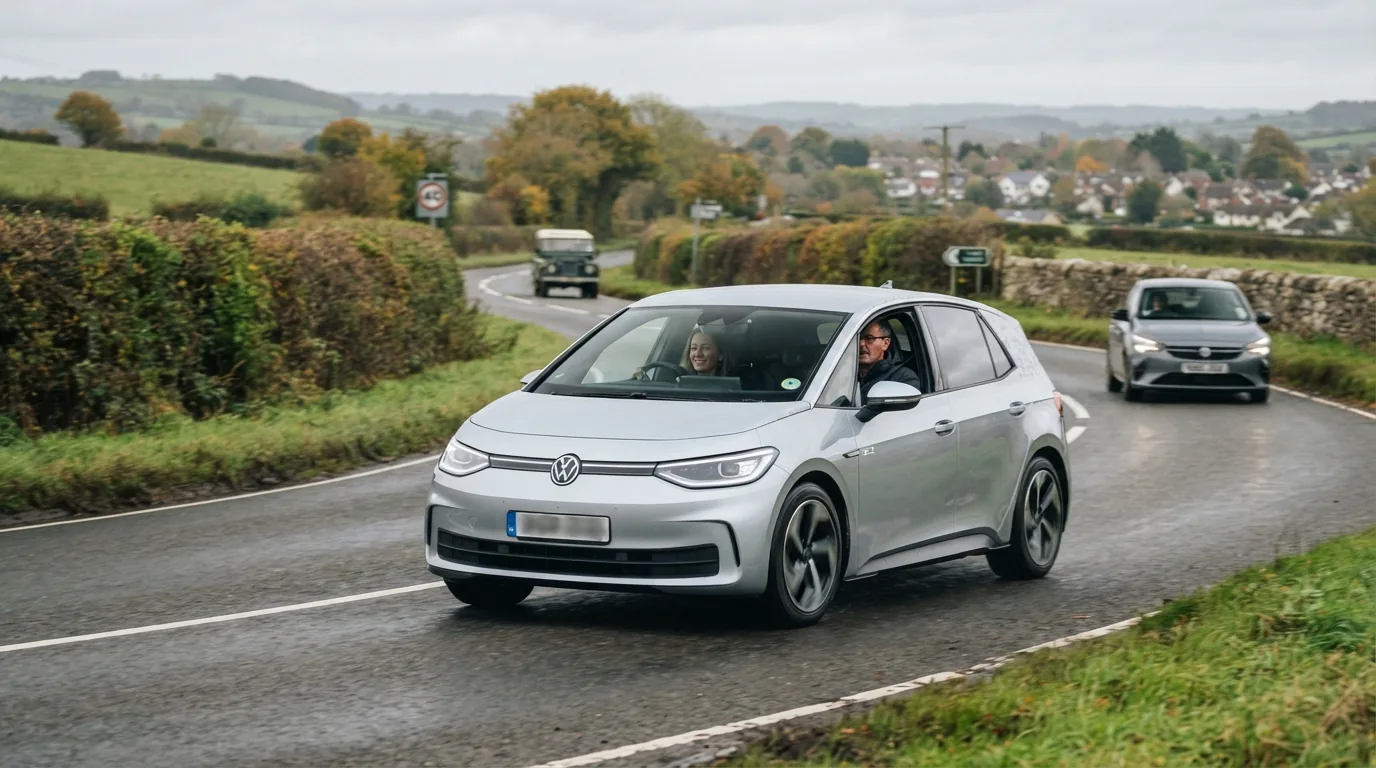
Volkswagen ID.2 prototype driven: the £22k people's EV takes shape
Our first time behind the wheel of VW's long-promised affordable electric hatchback ahead of its 2026 showroom debut. Range, pricing, specs and what it is really like to drive.
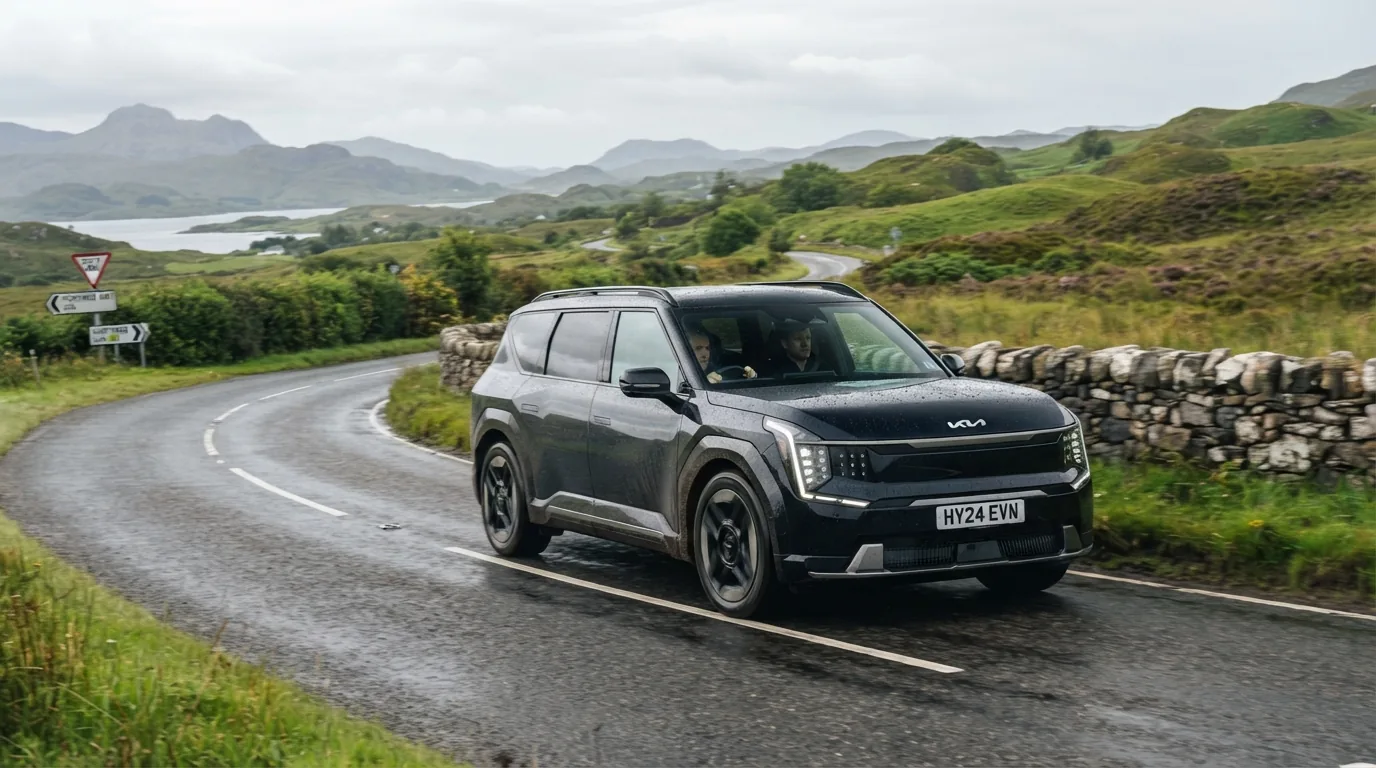
Hyundai Ioniq 9 first drive: the seven-seat electric SUV done properly
Spacious, comfortable and seriously efficient, Hyundai's biggest EV yet aims squarely at the family market. After driving it in the UK, we explain who it suits and where rivals still have an edge.