Ford E-Transit Custom gains bigger battery and 209-mile range
The UK's best-selling van goes further on a charge. We assess what the bigger battery means for tradespeople, payload, charging speed, and the case for switching from diesel.
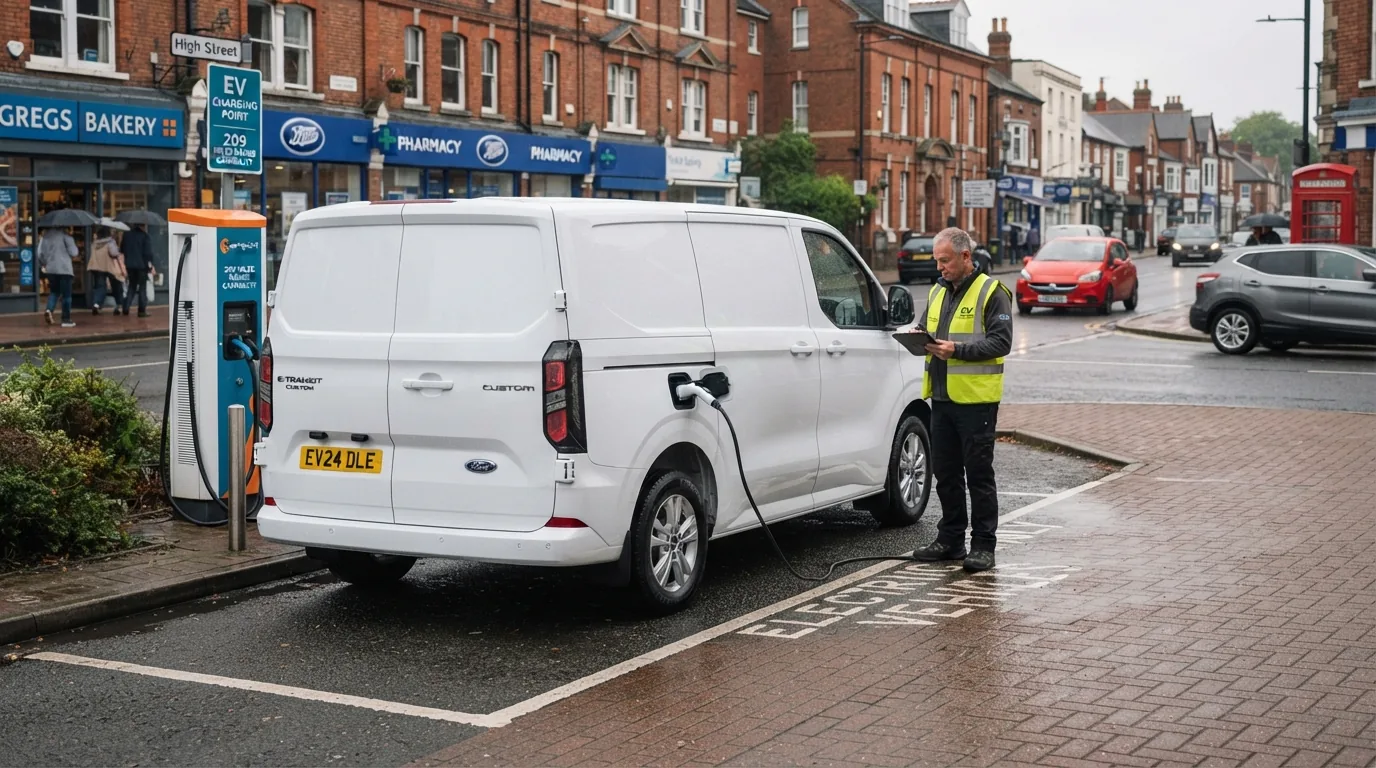
Quick answers
- The 2026 Ford E-Transit Custom gets a 71 kWh usable battery (up from 64 kWh), pushing WLTP range from 209 miles to 232 miles.
- Rapid charging improves significantly: 10-80% takes 29 minutes at 125 kW (down from 39 minutes). Existing owners receive an OTA update reducing their charge time to approximately 25 minutes.
- Real-world range at typical payload is approximately 170-190 miles depending on load and conditions, not the WLTP headline figure. No independent real-world test of the 71 kWh model has been published yet.
- Optional all-wheel drive is now available across all power variants, with 630 Nm torque at the top spec and a Trail mode for loose surfaces. Range impact is unconfirmed.
- Running costs on overnight depot charging are competitive with diesel at current rates; public rapid charging narrows the advantage substantially.
- The Transit Custom remains the UK's best-selling van (49,774 sales in 2025) and the electric version now has a strong enough range for most operators who can charge at base.
Ford E-Transit Custom: bigger battery, 232-mile range, and what it actually means for your business
The 2026 Ford E-Transit Custom gets a 71 kWh usable battery, pushing its WLTP range from 209 miles to 232 miles, and a new 125 kW DC charging capability that cuts the 10-80% charge time from 39 minutes to 29 minutes. Ford has also added an all-wheel-drive option for the first time, available across all power variants. These are meaningful numbers, not incremental ones.
Context matters here. The Ford Transit Custom is the UK’s best-selling van, with 49,774 units sold in 2025 alone. When Ford Pro updates the electric version, the entire van market pays attention. For a full rundown of the best electric vans on sale in the UK, see our electric van guide.
What has actually changed on the 2026 E-Transit Custom?
Three distinct updates arrive with models built from early 2026. Here is what each one delivers.
-
Battery capacity. The usable battery increases from 64 kWh to 71 kWh. The gross pack size is 74 kWh, and the physical form factor is unchanged, which matters for operators who have already specified body conversions or racking systems. The battery chemistry remains NCM (Nickel Cobalt Manganese) pouch cells.
-
Charging speed. The 10-80% rapid charge time drops from 39 minutes to 29 minutes using a 125 kW DC charger. A 10-minute charge at that speed adds approximately 69 miles of range. Notably, existing 64 kWh E-Transit Custom owners receive an over-the-air software update that reduces their charge time to approximately 25 minutes at 10-80%, which is actually quicker than the new model’s 29-minute figure at the same state of charge. If you already own one, watch for that OTA.
-
All-wheel drive. An independent electric drive unit is added to the front axle alongside the existing rear motor. Three power outputs are available: 136 hp, 217 hp, and 285 hp. The top AWD variant produces 630 Nm of torque. The system monitors wheel slip up to 50 times per second and includes a Trail mode for loose surfaces. More on who actually needs this below.
Here is how the key numbers stack up against the previous model:
| Specification | Previous (64 kWh) | Updated (71 kWh) |
|---|---|---|
| Usable battery | 64 kWh | 71 kWh |
| WLTP range | 209 miles | 232 miles |
| 10-80% charge time (125 kW) | 39 minutes | 29 minutes |
Pricing for the 71 kWh variant has not been confirmed at the time of writing. The current 64 kWh model starts from approximately £43,380 ex-VAT; the updated model is expected to carry a premium over that.
Real-world range: what to expect on a working day
WLTP figures are measured in laboratory conditions with no payload and near-ideal temperatures. UK operators loading tools, materials, or equipment are not driving in those conditions.
For the 64 kWh model, Van Reviewer’s real-world assessment puts the practical range at approximately 170 miles with some weight on board and normal mixed driving. At maximum payload (up to 1,100 kg), you should expect comfortably over 150 miles. The 71 kWh battery is roughly 11% larger than the 64 kWh unit, so real-world range should scale proportionally. That puts the honest working estimate at approximately 185-190 miles at typical payload, and 165 miles or more at maximum load. No independent real-world test of the updated 71 kWh model has been published as of May 2026, so these are estimates, not confirmed figures. Figures vary; verify current data as independent tests emerge.
Practical working range: approximately 185-190 miles (71 kWh, typical payload, mixed driving)
Cold weather is a separate factor. Winter temperatures can reduce EV range by 20-30%, and this applies to every electric van on the market. An E-Transit Custom doing 170 miles in summer may manage 120-135 miles in January. If your typical daily route is under 120 miles and you charge at base overnight, this rarely creates a problem. If your routes routinely push 150 miles in winter, plan an occasional top-up.
How the charging works, including overnight at base
Most operators will charge at a depot, yard, or workshop overnight. That is the scenario where the economics work best, and it is the one most relevant to fleet planning.
Overnight and depot charging. The E-Transit Custom comes with an 11 kW three-phase AC onboard charger as standard. A full charge from empty on a three-phase supply takes approximately 6 hours 40 minutes, which fits comfortably into any overnight window. On a 7 kW single-phase wallbox, expect roughly 9 hours.
At a typical UK business electricity rate of approximately 24p per kWh, a full 71 kWh charge costs roughly £17. At an off-peak overnight rate of around 10p per kWh (using Economy 7 or a dedicated EV tariff), that drops to approximately £7.10. For comparison, a Transit Custom diesel covering 170 miles at approximately 35 mpg uses roughly 4.9 litres of diesel. At approximately £1.50 per litre, that is roughly £7.35 for the same distance. At cheap overnight rates, the energy costs are broadly equivalent; as diesel prices rise, the electric advantage widens. These figures are illustrative estimates based on published electricity rates and industry mpg figures, not official Ford or Ofgem data. Actual savings depend on your tariff, mileage, and charging behaviour.
On-the-road rapid charging. When you need to top up away from base, the 125 kW DC rapid charger delivers 10-80% in 29 minutes. A 10-minute stop adds approximately 69 miles. That is a genuinely useful figure for splitting a long day’s work without a lengthy break.
Public rapid charging costs are a different matter. Average UK rapid charging rates in 2026 run at approximately 65-75p per kWh, which puts a 10-80% fill at approximately £33-38. If your operation relies primarily on public rapid charging rather than overnight depot power, the cost advantage narrows significantly. Public charging costs are falling, and our piece on why public charging costs are falling explains the longer-term picture, but at today’s rates, rapid-charge-dependent operations need to model the numbers carefully before committing.
How it compares to rivals on range and price
The E-Transit Custom sits in a competitive class. Here is where the main alternatives stand on the metrics that matter most to operators.
| Van | WLTP range | Starting price ex-VAT (approx) | Payload |
|---|---|---|---|
| Ford E-Transit Custom (71 kWh, 2026) | 232 miles | TBC (64 kWh from ~£43,380) | 1,088 kg |
| Vauxhall Vivaro Electric | ~219 miles | ~£38,000 (after grant) | ~1,000 kg |
| Peugeot e-Expert | ~230 miles | Not confirmed | ~1,000 kg+ |
| VW ID. Buzz Cargo | ~277 miles | ~£42,000 | ~650 kg |
Note: Vivaro Electric and ID. Buzz Cargo prices and ranges are drawn from search summaries and should be verified directly with manufacturers before making procurement decisions. Peugeot e-Expert pricing is not confirmed here.
The headline comparison is with the Vauxhall Vivaro Electric. The Vivaro comes in at roughly £5,000 less before the grant, which is a real difference. Against that, the E-Transit Custom offers more payload (1,088 kg versus approximately 1,000 kg), more power options including the new AWD variant, and the broadest dealer and service network of the group. If load capacity is the priority, the Ford’s edge is clear.
The VW ID. Buzz Cargo leads on range at approximately 277 miles WLTP, but its payload of roughly 650 kg puts it in a different category for working use. It suits lighter commercial loads and courier applications more than builders or tradespeople who regularly carry heavy materials.
All four models qualify for the Plug-in Van Grant, which covers 35% of the vehicle price up to a maximum of £5,000. The discount applies automatically at point of sale through approved dealers, so you do not need to claim it separately.
Running costs and the business case
The upfront cost of the E-Transit Custom is real, and so is the running cost saving. The question for any operator is whether the saving justifies the premium over their current diesel over the lifecycle of the vehicle.
At 10p per kWh on an overnight depot tariff, the cost of running the E-Transit Custom works out at approximately 4p per mile. A diesel Transit Custom at 35 mpg and £1.50 per litre diesel costs approximately 19p per mile. On a van covering 25,000 miles per year, the energy saving alone is approximately £3,750 annually. These are illustrative calculations using the electricity rates and diesel price stated above; your actual saving depends on your tariff, route mix, and fuel prices at the time. They are broadly right, not exact.
Servicing adds to the case. Electric vans have no exhaust, no clutch, no timing belt, and no diesel particulate filter. The scheduled maintenance intervals are simpler and typically less frequent. Ford Pro offers service packages. Independent UK data on total cost of ownership for electric versus diesel at fleet scale is still limited, and we will not pretend otherwise.
The regulatory environment is also shifting in favour of zero-emission vans. The ZEV mandate targets mean 24% of new van registrations must be zero-emission in 2026, rising steeply each year, reaching 70% by 2030. Non-compliance carries a fine of £18,000 per van for manufacturers who miss targets. Fleet operators who delay switching face a market where ICE van options become progressively fewer and potentially more expensive as production capacity shifts.
On urban operations, the regulatory picture is straightforward. Electric vans remain fully ULEZ-exempt in 2026. The Congestion Charge position changed in January 2026: electric vehicles are no longer fully exempt, but electric vans qualify for a 50% discount when registered on TfL’s Auto Pay system. Clean Air Zone charges in Birmingham and other UK cities do not apply to electric vans. ULEZ exemption and Congestion Charge discount are separate schemes; the distinction matters if your drivers operate in central London regularly.
The all-wheel-drive option: who needs it?
AWD is a genuine addition to the E-Transit Custom’s capability, but it is a niche choice and worth treating as such.
The system works by adding an independent electric drive unit to the front axle, complementing the existing rear motor. At the top spec, it produces 630 Nm of torque. The wheel-slip monitoring runs at 50 times per second, and Trail mode is designed for loose or muddy surfaces. Regenerative braking is enhanced by approximately 50% on AWD models compared to the RWD version.
The range impact of adding AWD has not been confirmed by Ford at the time of writing. Dual-motor setups typically reduce efficiency compared to a single rear motor, so expect some reduction in real-world range, though the exact figure is unknown until independent tests are published. Figures vary on this point; verify current data before speccing an AWD van if range is a priority.
AWD pricing has not been announced. A premium over the equivalent RWD variant is expected.
For most operators, RWD is sufficient. Urban tradespeople, delivery operations, and anyone running on sealed roads will not benefit meaningfully from AWD. The operators who will find it genuinely useful are those working on unmade surfaces regularly: builders on active sites, groundwork contractors, rural operators, and those doing frequent towing up to the van’s 2,300 kg limit. If that describes your operation, the AWD option is worth tracking when specifications and pricing are confirmed.
Is the updated E-Transit Custom worth buying now?
We think the case for the 71 kWh E-Transit Custom is clear for operators with one specific profile: overnight charging at a yard or depot, and a typical daily mileage under 150 miles. For that majority, the updated battery removes the last significant range concern. You top up overnight, start each day with a full charge, and the 185-190 mile real-world range gives you a comfortable buffer. The faster charging time is a bonus rather than a necessity, but it is a good one.
For operators who rely primarily on public rapid charging rather than depot power, the picture is harder. At 65-75p per kWh on a public charger, the fuel cost saving over diesel shrinks or disappears entirely. If you cannot install a depot charger or workplace charging point, model the public charging cost carefully before committing.
On AWD: we would suggest waiting. No independent range or payload tests on the AWD variant have been published. Commit to the premium only once you have solid real-world numbers.
What the E-Transit Custom has in its favour beyond the spec sheet is familiarity. Transit Custom drivers adapt quickly because the cabin and driving experience are deliberately close to the diesel version. The Ford Pro telematics, charging management software, and the dealer network are all established, not promises. For a small fleet switching its first electric van, that matters.
Ready to compare all electric vans side by side? Browse all electric vans on EV Compared.
How we test and where our numbers come from
Range figures are official WLTP combined values taken from manufacturer UK specification pages, with real-world estimates drawn from independent comparative testing. Prices are UK list prices at the time of the latest update. Tax, grant and charging-scheme figures come from GOV.UK and HMRC publications. We re-check every guide when pricing, specification or policy changes. Last checked 11 August 2026.
Frequently asked questions
What has actually changed on the 2026 E-Transit Custom?
Three distinct updates arrive with models built from early 2026. Here is what each one delivers.
The all-wheel-drive option: who needs it?
AWD is a genuine addition to the E-Transit Custom's capability, but it is a niche choice and worth treating as such.
Is the updated E-Transit Custom worth buying now?
We think the case for the 71 kWh E-Transit Custom is clear for operators with one specific profile: overnight charging at a yard or depot, and a typical daily mileage under 150 miles. For that majority, the updated battery removes the last significant range concern.
Sources and further reading
- ford.co.ukFord E-Transit Custom official pageManufacturer spec source for official range, pricing, and trim data
- gov.ukZEV mandate GOV.UK guidancePolicy source for fleet operators planning future procurement
- gov.ukPlug-in Van Grant portal guidance (GOV.UK)Official grant eligibility and application process for operators

EV Compared
The EV Compared editorial team tracks the UK electric vehicle market full time: new model launches, list prices, WLTP and real-world range, public charging tariffs and the tax rules that decide what an EV actually costs to run. Every guide is checked against manufacturer specifications and official GOV.UK figures, and updated whenever the numbers move.
Related reading
View all
Inside Britain's £1.2bn gigafactory gamble, and the EVs it will power
The UK's largest battery plant breaks ground this summer. We report on who is building it, which carmakers are lined up, and whether the industrial bet can pay off.
Kia EV3 review: the small electric SUV that finally gets the basics right
A 375-mile claimed range, a genuinely usable interior and a price that makes sense. We put Kia's compact SUV through a week of British weather to see if the real world matches the spec sheet.
National Grid confirms 6,000 new rapid chargers for motorway network by 2027
A major expansion of high-power charging promises to end the queues at motorway services. We break down where the new units are going, which networks are involved, and what it means for long trips.