How Does the Workplace Charging Scheme Work in 2026?
Everything UK businesses need to know about the government grant covering 75% of EV chargepoint installation costs
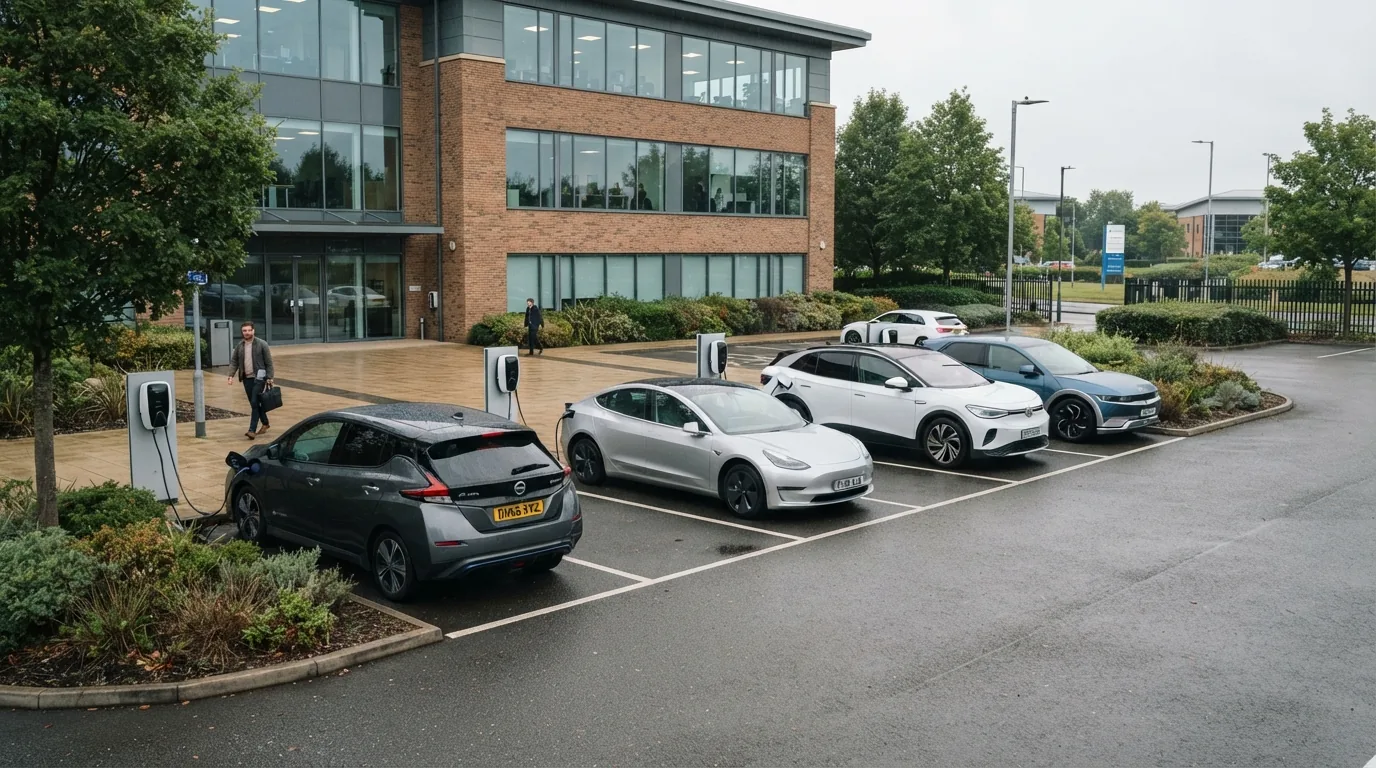
Quick answers
- The Workplace Charging Scheme (WCS) is a UK government grant that covers 75% of the cost of purchasing and installing EV chargepoints at business premises, up to £500 per socket.
- Individuals cannot apply through the WCS; that route is covered by the separate home chargepoint grant for renters and flat-owners.
- How does the application process work: The whole process typically takes a few weeks from application to approval.
- What chargepoints are covered: The WCS covers tethered and untethered AC chargepoints (generally 7kW units for workplace use, sometimes 22kW three-phase units).
- If you are a commercial landlord with off-street parking at a business premises you own, you may be eligible as a property owner.
- Yes, and this is one of the best reasons for businesses to install workplace charging even if they have no company EVs.
The Workplace Charging Scheme (WCS) is a UK government grant that covers 75% of the cost of purchasing and installing EV chargepoints at business premises, up to £500 per socket. From 1 April 2026, the maximum grant rate increased from £350 to £500, and organisations can apply for up to 40 sockets across all their sites, giving a maximum possible grant of £20,000. The scheme runs to 31 March 2027.
Who can apply for the Workplace Charging Scheme?
The WCS is open to three categories of organisation:
- Businesses: any UK-registered company, including sole traders and partnerships
- Charities: registered charities with UK premises
- Public sector organisations: including local authorities, NHS trusts, schools, universities and government agencies
Individuals cannot apply through the WCS; that route is covered by the separate home chargepoint grant for renters and flat-owners.
What are the eligibility conditions?
To qualify, your organisation must meet both applicant and site criteria:
Applicant criteria:
- You must be a UK-based business, charity or public sector body
- You must own or have evidence of a legitimate interest in the property (or have landlord consent if you are leasing the premises)
Site criteria:
- The site must have dedicated off-road parking clearly associated with the premises. Parking that is shared with the public or not directly linked to the business generally does not qualify.
- You must not have already received a WCS grant for that specific location at the maximum level
Key rule: You must apply and receive approval before any chargepoints are purchased or installed. Installing first and applying afterwards voids the grant.
How much is the grant?
| Parameter | Amount |
|---|---|
| Grant rate | 75% of purchase and installation cost |
| Maximum per socket (from 1 April 2026) | £500 |
| Maximum sockets per applicant | 40 (across all sites) |
| Maximum total grant | £20,000 |
Before 1 April 2026 the cap was £350 per socket. The increase to £500 was announced as part of the April 2026 changes to OZEV chargepoint grant schemes. The 40-socket limit applies across all of an organisation’s UK sites, not per site.
How does the application process work?
- Check eligibility. Review the applicant and site criteria on GOV.UK before starting.
- Apply via the OZEV portal. Submit your application on the OZEV online platform. Do not order or install chargepoints yet.
- Receive approval. OZEV reviews your application and issues a grant eligibility notification.
- Arrange installation. You must use an OZEV-approved installer. Using a non-approved installer voids the grant.
- Installer claims the grant. After installation, your approved installer claims the grant directly from OZEV and deducts it from your invoice. You pay only the remaining 25%.
The whole process typically takes a few weeks from application to approval. OZEV’s guidance is that the scheme is oversubscribed at certain periods, so applying early in your planning process is advisable.
What chargepoints are covered?
The WCS covers tethered and untethered AC chargepoints (generally 7kW units for workplace use, sometimes 22kW three-phase units). Rapid DC chargers can be eligible but the grant rate of £500 per socket applies regardless of the charger’s power output; a 150kW rapid charger costs far more than £667 (the threshold at which 75% equals £500), so the grant represents a smaller proportion of the cost for high-powered units.
The chargepoint must be a new installation; retrofitting or upgrading an existing charger does not qualify.
Does the Workplace Charging Scheme cover landlords?
If you are a commercial landlord with off-street parking at a business premises you own, you may be eligible as a property owner. The WCS does not cover residential landlord situations, which are handled by the separate EV Chargepoint Grant for residential landlords (also up to £500 per socket, through the same OZEV framework).
Can employees benefit from workplace chargepoints?
Yes, and this is one of the best reasons for businesses to install workplace charging even if they have no company EVs. Since April 2016, a specific HMRC exemption means employees who charge their personal electric car at work pay no Benefit in Kind tax on that charging benefit. Employers can provide free or subsidised workplace charging to employees without any P11D reporting obligation, provided the chargepoint is available to all employees generally (not just directors or specific individuals).
This exemption does not extend to home charging costs reimbursed by employers, which is a separate and more complex area. But free workplace charging is genuinely tax-free for employees.
What happens after 31 March 2027?
The government has described the current five-grant OZEV portfolio as the “final year” of the scheme with a simplified structure. Whether a successor programme launches in April 2027 has not been confirmed. OZEV’s position is that the commercial market for workplace chargepoints is maturing and that public subsidy should reduce as chargepoint installation becomes more routine for businesses.
Organisations planning to install workplace chargepoints should apply under the current scheme before it closes, rather than waiting to see whether a 2027/28 programme follows.
How does the WCS interact with other schemes?
Salary sacrifice. If your business runs a salary sacrifice EV scheme, having workplace charging significantly increases the value of the scheme to employees. Employees who charge at work effectively pay for almost none of their fuel, making the monthly sacrifice cost even more attractive.
Electric Car Grant. The WCS and the ECG are entirely separate and can be claimed simultaneously. A business buying an eligible EV for an employee can claim the ECG discount at the dealer and the WCS grant for installation.
LEVI Fund. The Local Electric Vehicle Infrastructure Fund is for public chargepoints on local authority land; it does not overlap with the WCS.
Common mistakes
Buying and installing chargepoints before applying. This is the most common reason for failed claims. The OZEV approval must come first.
Assuming any parking counts. Parking that is not clearly dedicated to the premises (for example, shared public car parks) does not qualify.
Using a non-approved installer. The installer must be on OZEV’s approved list. Check before commissioning any work.
Missing the 40-socket cap. Organisations with multiple sites sometimes plan for more than 40 sockets and are surprised to find the total grant is capped. Plan across all sites together.
Forgetting the March 2027 deadline. Applications and installations need to be completed within the scheme period. Allow adequate lead time for procurement, approval and installation.
What to do next
If your business, charity or public sector organisation has off-road parking and has not yet installed EV chargepoints, the WCS is worth prioritising before the March 2027 deadline. Apply via OZEV’s online portal and engage an approved installer for quotes.
For the broader grant landscape including car purchase subsidies, see our overview of what EV grants are available in the UK. For the full policy context, return to the grants, policy and legislation hub.
How we test and where our numbers come from
Range figures are official WLTP combined values taken from manufacturer UK specification pages, with real-world estimates drawn from independent comparative testing. Prices are UK list prices at the time of the latest update. Tax, grant and charging-scheme figures come from GOV.UK and HMRC publications. We re-check every guide when pricing, specification or policy changes. Last checked 11 August 2026.
Frequently asked questions
Who can apply for the Workplace Charging Scheme?
Individuals cannot apply through the WCS; that route is covered by the separate home chargepoint grant for renters and flat-owners.
How much is the grant?
Before 1 April 2026 the cap was £350 per socket. The increase to £500 was announced as part of the April 2026 changes to OZEV chargepoint grant schemes.
How does the application process work?
The whole process typically takes a few weeks from application to approval. OZEV's guidance is that the scheme is oversubscribed at certain periods, so applying early in your planning process is advisable.
What chargepoints are covered?
The WCS covers tethered and untethered AC chargepoints (generally 7kW units for workplace use, sometimes 22kW three-phase units).
Does the Workplace Charging Scheme cover landlords?
If you are a commercial landlord with off-street parking at a business premises you own, you may be eligible as a property owner. The WCS does not cover residential landlord situations, which are handled by the separate EV Chargepoint Grant for residential landlords (also up to £500 per socket, through the same OZEV framework).
Sources and further reading
- gov.ukGOV.UK OZEVPrimary source referenced in this article.

EV Compared
The EV Compared editorial team tracks the UK electric vehicle market full time: new model launches, list prices, WLTP and real-world range, public charging tariffs and the tax rules that decide what an EV actually costs to run. Every guide is checked against manufacturer specifications and official GOV.UK figures, and updated whenever the numbers move.
Related reading
View all
What Does the 2030 Petrol and Diesel Ban Actually Mean?
Separating the facts from the myths: what changes in 2030, what does not, and what it means for your next car

Best Affordable EVs Under the Electric Car Grant
The electric cars that combine a government grant with the lowest purchase prices in the UK market right now

What Is the Benefit in Kind Rate for Electric Cars?
The electric car BiK rate is 4% for 2026/27, rising to 9% by 2029/30 on a confirmed schedule. Here is what that means for your tax bill, with worked examples and a full multi-year projection.