What Government Support Exists for EV Charging Infrastructure?
From individual socket grants to £381 million for public chargepoints: the full picture of UK government EV charging investment in 2026
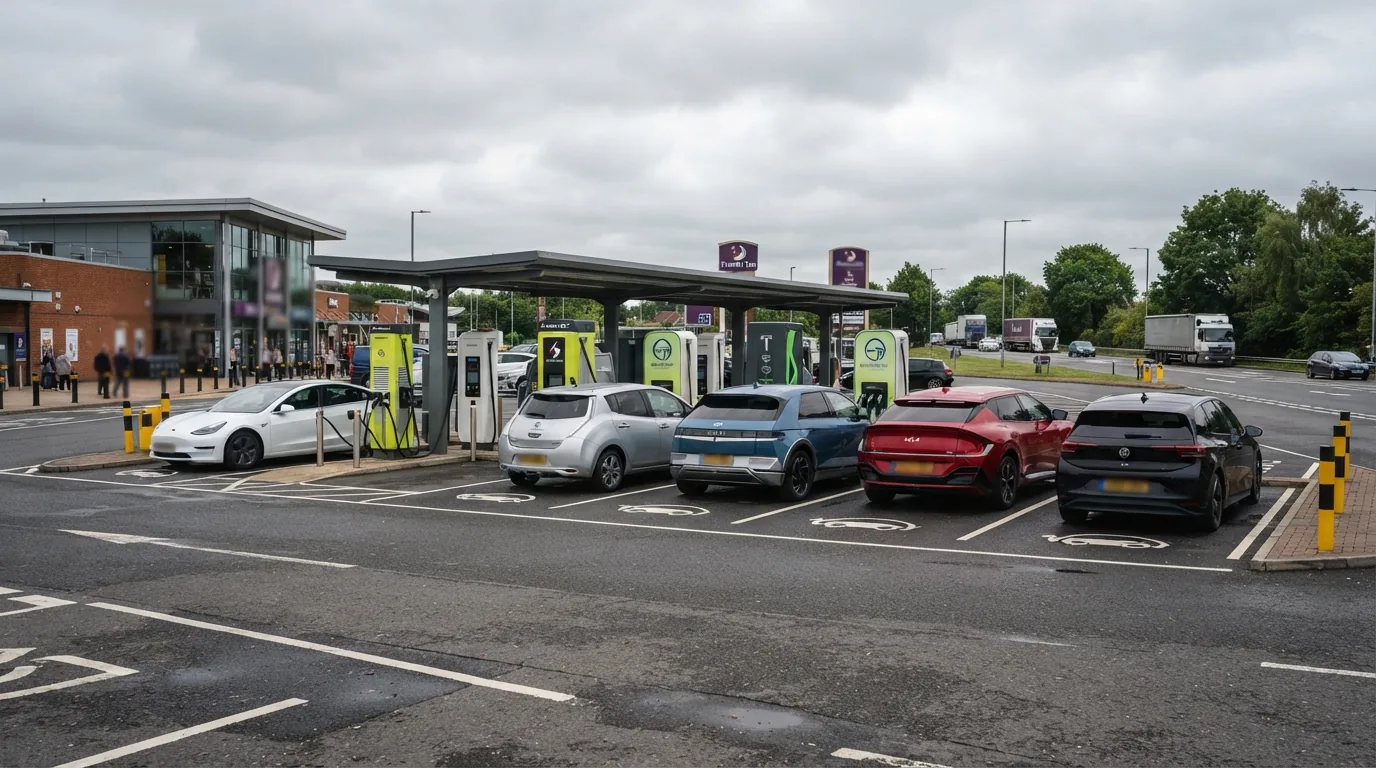
Quick answers
- UK government support for EV charging infrastructure in 2026 operates at four levels: individual home chargepoint grants, workplace installation grants, local authority public charging investment and national motorway and strategic road network funding.
- Individual home chargepoint grants: From 1 April 2026, the maximum grant rate increased from £350 to £500 per socket for both schemes.
- Workplace Charging Scheme: The Workplace Charging Scheme (WCS) is the main vehicle for getting EV chargepoints into business premises, charity sites and public sector buildings.
- The LEVI Fund is the government's flagship programme for expanding the public charging network, particularly in areas that private investment has not yet reached.
- Beyond infrastructure grants, the government committed £10 million in 2025 for technology development to enable ultra-rapid EV charging without large grid connections.
- Motorway and strategic road network: The Rapid Charging Fund was established to subsidise the grid connection costs for ultra-rapid chargepoints at motorway service areas.
UK government support for EV charging infrastructure in 2026 operates at four levels: individual home chargepoint grants, workplace installation grants, local authority public charging investment and national motorway and strategic road network funding. Altogether, the government has committed over £2.3 billion to EV charging infrastructure through a combination of grants, loans and contracted delivery programmes. Here is what is active, who it helps and where the money is going.
Individual home chargepoint grants
| Grant | Eligible applicants | Maximum per socket | Scheme end date |
|---|---|---|---|
| EV Chargepoint Grant (renters/flats) | Renters and flat owner-occupiers | £500 (75% of cost) | 31 March 2027 |
| EV Chargepoint Grant (residential landlords) | Residential landlords | £500 (75% of cost) | 31 March 2027 |
From 1 April 2026, the maximum grant rate increased from £350 to £500 per socket for both schemes. Homeowners with a house and a driveway are no longer eligible under the OZEV framework; the home grant is now focused on renters, flat-owners and landlords who face structural barriers to installation.
Both grants cover 75% of the combined purchase and installation cost, up to £500. The grant is deducted from the installer’s invoice; you pay the remaining 25%. You must use an OZEV-approved installer and must own or have a qualifying lease on an OZEV-approved EV before applying.
Workplace Charging Scheme
The Workplace Charging Scheme (WCS) is the main vehicle for getting EV chargepoints into business premises, charity sites and public sector buildings. From 1 April 2026:
- Grant rate: 75% of cost, up to £500 per socket
- Maximum sockets: 40 across all an organisation’s sites
- Maximum total grant: £20,000
- Eligible applicants: businesses, charities and public sector bodies with dedicated off-road parking
This scheme runs to 31 March 2027. Organisations must apply before installation begins; installing chargepoints before receiving OZEV approval voids the grant. The application is made through the OZEV online portal using an approved installer.
Local Electric Vehicle Infrastructure (LEVI) Fund
The LEVI Fund is the government’s flagship programme for expanding the public charging network, particularly in areas that private investment has not yet reached. Key facts:
- Total fund: £381 million allocated to English local authorities
- Target: over 100,000 new public chargepoints from this fund alone
- Delivery: local authorities commission chargepoint installation through procurement contracts with approved providers
- Focus: primarily lower-powered local chargepoints in residential streets, car parks and community facilities, though rapid charging is eligible as part of wider projects
Most local authorities completed their LEVI procurement processes by March 2026 and installations are accelerating through 2026 and 2027. A new EV Infrastructure Support Service (run by Energy Saving Trust, Cenex and PA Consulting) launched in April 2026 to help councils that struggled with procurement.
The LEVI Fund does not involve direct grants to individuals; it is a programme contracted by councils to install chargepoints on public land for general use.
Rapid charging: Innovate UK technology investment
Beyond infrastructure grants, the government committed £10 million in 2025 for technology development to enable ultra-rapid EV charging without large grid connections. Funded projects must enable at least 12 vehicles to access ultra-rapid charging (delivering roughly 120 to 145 miles of range in 15 minutes) using innovative grid-independent or off-grid approaches. Innovate UK administered the competition with a March 2026 application deadline.
This is a technology investment rather than a consumer or operator infrastructure grant, but its output will be deployable rapid charging technology that does not require expensive grid upgrades at each site.
Motorway and strategic road network
The Rapid Charging Fund was established to subsidise the grid connection costs for ultra-rapid chargepoints at motorway service areas. Grid connections at motorway locations can cost £500,000 to £1 million or more, making commercial investment in high-powered chargers (150kW to 350kW) difficult to justify without subsidy. The Rapid Charging Fund bridges this gap for qualifying sites.
As a result, most UK motorway service areas now have or are installing ultra-rapid charging hubs. Operators including Gridserve, Osprey, BP Pulse and MFG EV Power have all benefited from this programme. The government’s target is for every motorway service area to have at least six ultra-rapid chargepoints.
Scotland, Wales and Northern Ireland
Devolved governments run their own charging investment programmes alongside the OZEV grants (which are UK-wide for home and workplace grants):
- Scotland: The Scottish Government’s Switched On Towns and Cities programme and the Zero Emission Vehicles Scotland fund have funded thousands of public chargepoints. Scotland has a higher public chargepoint density than England relative to its EV fleet size.
- Wales: The EV Charging Network Wales programme is delivering charging in public car parks, community facilities and workplaces.
- Northern Ireland: OZEV chargepoint grants apply here as in the rest of the UK. The Department for Infrastructure NI has its own supplementary programmes.
Private sector investment alongside government funding
The government’s stated position is that public funding should crowd in private investment, not replace it. The target is £6 billion in private investment in EV charging infrastructure by 2030. Major energy companies, oil majors (bp, Shell), specialist operators (Pod Point, Zap-Map, Osprey) and automakers have all committed capital to UK public charging, partly driven by commercial opportunity and partly by the ZEV Mandate’s effect on EV volumes.
In practice, private investment is concentrated in the most commercially attractive locations: motorways, retail parks and urban rapid charging hubs. The LEVI Fund exists precisely because private investment has not found it commercially viable to serve residential streets, rural communities and areas with lower EV penetration.
What is the current state of the public charging network?
As of early 2026, the UK has over 70,000 public charging points across more than 40,000 locations (Zap-Map data). The split is approximately:
- Slow chargers (up to 7kW): roughly 35% of locations
- Fast chargers (7kW to 22kW): roughly 45% of locations
- Rapid (50kW+): roughly 15% of locations
- Ultra-rapid (150kW+): growing rapidly, particularly at motorway service areas
The network has grown significantly but coverage remains uneven. Rural areas and parts of northern England, Wales and Northern Ireland lag behind the density available in London and the South East.
Common misunderstandings about EV charging support
“The government stopped supporting home charging.” Partially true but misleading. The grant for homeowners with driveways ended; grants for renters, flat-owners and landlords continue at a higher rate (£500 per socket from April 2026).
“All the public charging money goes to motorway services.” The LEVI Fund is specifically targeted at local authority areas that are underserved, including residential streets and rural locations. Motorway charging has separate Rapid Charging Fund support.
“Private charging is fast enough; there’s no need for public investment.” Around 40% of UK households have no access to off-street parking and cannot install a home charger. For these households, accessible, affordable and reliable public charging is the only option. Government investment in public charging is a direct enabler of EV ownership for a large segment of the population.
What to do next
If you are a renter, flat-owner or landlord, investigate the £500 home chargepoint grant via an OZEV-approved installer. If you run a business, charity or public sector organisation, apply for the Workplace Charging Scheme before the March 2027 deadline.
For the full grants picture including car purchase subsidies, see our overview of what EV grants are available in the UK. For the complete policy landscape, return to the grants, policy and legislation hub.
How we test and where our numbers come from
Range figures are official WLTP combined values taken from manufacturer UK specification pages, with real-world estimates drawn from independent comparative testing. Prices are UK list prices at the time of the latest update. Tax, grant and charging-scheme figures come from GOV.UK and HMRC publications. We re-check every guide when pricing, specification or policy changes. Last checked 11 August 2026.
Frequently asked questions
What is the current state of the public charging network?
The network has grown significantly but coverage remains uneven. Rural areas and parts of northern England, Wales and Northern Ireland lag behind the density available in London and the South East.
Sources and further reading
- gov.ukGOV.UK OZEVPrimary source referenced in this article.

EV Compared
The EV Compared editorial team tracks the UK electric vehicle market full time: new model launches, list prices, WLTP and real-world range, public charging tariffs and the tax rules that decide what an EV actually costs to run. Every guide is checked against manufacturer specifications and official GOV.UK figures, and updated whenever the numbers move.
Related reading
View all
What Does the 2030 Petrol and Diesel Ban Actually Mean?
Separating the facts from the myths: what changes in 2030, what does not, and what it means for your next car
Best Affordable EVs Under the Electric Car Grant
The electric cars that combine a government grant with the lowest purchase prices in the UK market right now

What Is the Benefit in Kind Rate for Electric Cars?
The electric car BiK rate is 4% for 2026/27, rising to 9% by 2029/30 on a confirmed schedule. Here is what that means for your tax bill, with worked examples and a full multi-year projection.