Tesla Model Y vs BMW iX1: Best Company Car EV in the UK?
Head-to-head on specs, BIK tax, charging and real-world usability for 2026
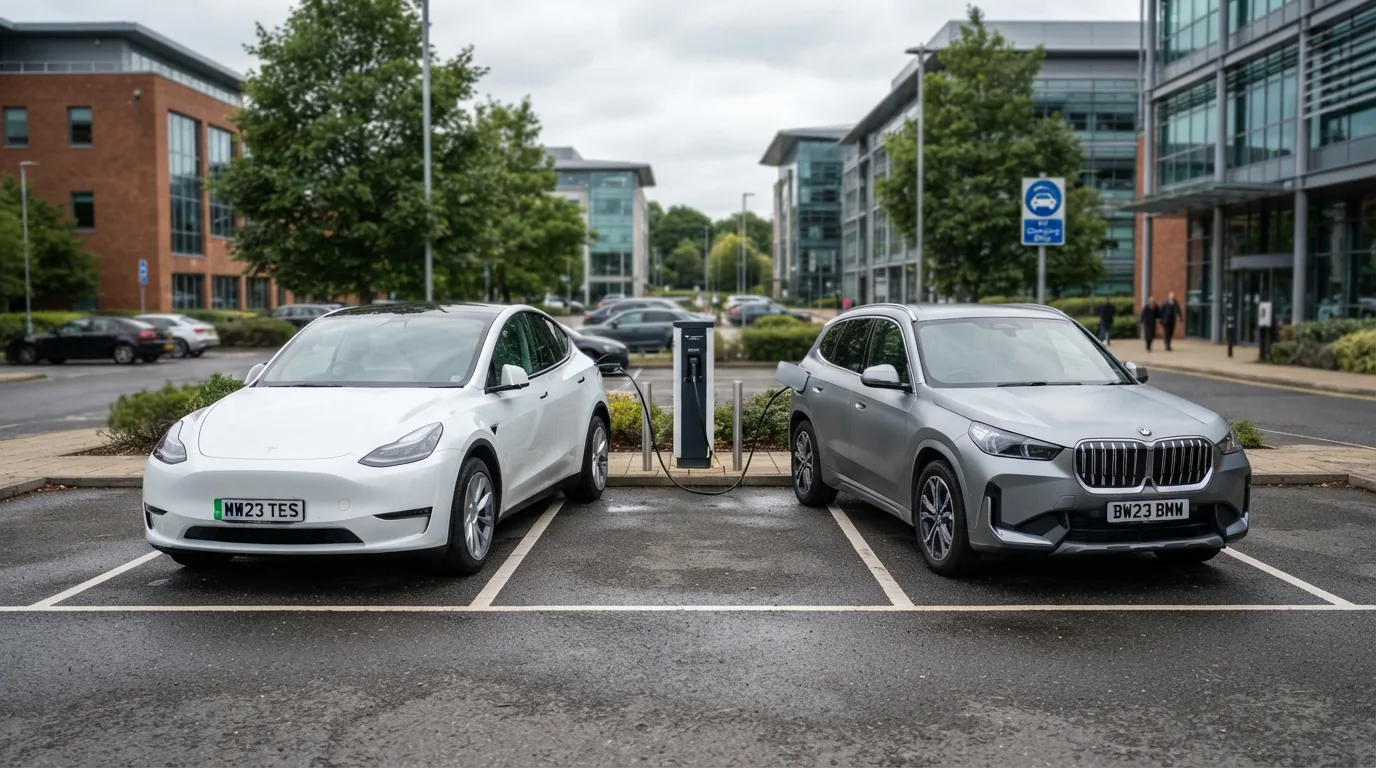
Quick answers
- The Tesla Model Y and BMW iX1 are the two most cross-shopped compact electric SUVs in the UK company car market. Both attract the same 4% BIK rate in 2026/27, but they differ significantly on range, charging speed, interior quality and price.
- Note: P11D values are approximate and depend on exact specification.
- Range: Tesla wins significantly: The Model Y RWD achieves 390 miles WLTP versus the iX1's 272 miles.
- The Model Y charges at up to 250kW on a Tesla Supercharger, reaching 10–80% in approximately 20 minutes.
- Boot space: no contest: The Model Y's 854-litre boot (plus a 117-litre frunk) is dramatically larger than the iX1's 490-litre boot.
- The Tesla Model Y's interior has improved with recent updates.
The Tesla Model Y and BMW iX1 are the two most cross-shopped compact electric SUVs in the UK company car market. Both attract the same 4% BIK rate in 2026/27, but they differ significantly on range, charging speed, interior quality and price. Our verdict: the Tesla Model Y is the more rational company car choice for the majority of UK drivers, offering more range, faster charging and a lower real-world monthly cost than the iX1. The BMW wins on interior quality, dealer network and the prestige some company car drivers want from a German badge. Here is the full comparison.
Head-to-head: key specs and company car costs
| Tesla Model Y RWD | BMW iX1 eDrive20 | BMW iX1 xDrive30 | |
|---|---|---|---|
| P11D value | ~£46,000 | ~£43,905 | ~£49,620 |
| WLTP range | 390 miles | 272 miles | 269 miles |
| Real-world range (motorway) | ~300–320 miles | ~210–225 miles | ~205–220 miles |
| Peak DC charging | 250 kW | 130 kW | 130 kW |
| 10–80% charge time | ~20 minutes | ~31 minutes | ~31 minutes |
| Boot space | 854 litres | 490 litres | 490 litres |
| Annual BIK (40% taxpayer) | £736 | £702 | £793 |
| Monthly BIK (40%) | £61 | £59 | £66 |
| Charging network | Tesla Supercharger | Public network | Public network |
Note: P11D values are approximate and depend on exact specification. BIK figures use the 4% 2026/27 rate.
Range: Tesla wins significantly
The Model Y RWD achieves 390 miles WLTP versus the iX1’s 272 miles. In real-world motorway driving, the gap narrows slightly but remains substantial: the Model Y delivers around 300–320 miles at 70 mph; the iX1 manages 210–225 miles. For a company car driver making longer inter-city journeys, this difference matters considerably. A driver going from Manchester to London (200 miles) can complete the journey in the Model Y without charging. In the iX1, they need a motorway stop, adding time and uncertainty.
For urban or suburban company car drivers covering under 150 miles per day, the iX1’s range is adequate, and the difference becomes academic.
Charging: Tesla’s Supercharger advantage is real
The Model Y charges at up to 250kW on a Tesla Supercharger, reaching 10–80% in approximately 20 minutes. The iX1 peaks at 130kW DC, taking around 31 minutes for the same top-up. The time difference is modest on a single stop but meaningful over a year of regular business travel.
More importantly, Tesla’s Supercharger network now has over 1,500 UK locations, most of which are reliable, well-maintained, and easy to find via the Tesla app or in-car navigation. BMW drivers on the public network (Gridserve, Osprey, Osprey, BP Pulse and others) encounter more variability in reliability and pricing.
Tesla opened the Supercharger network to non-Tesla vehicles, and BMW drivers can now access Superchargers via the ABRP or Plugshare apps or directly via credit card. However, the Model Y remains natively integrated with Supercharger routing and pricing, which is a smoother experience.
Boot space: no contest
The Model Y’s 854-litre boot (plus a 117-litre frunk) is dramatically larger than the iX1’s 490-litre boot. For business drivers who carry product samples, tools, luggage, or equipment, this difference has practical significance. The Model Y’s flat floor and wide opening also make loading and unloading easier.
The iX1’s 490 litres expands to 1,495 litres with rear seats folded, which is reasonable but still below the Model Y when configured similarly.
Interior: BMW wins on quality and familiarity
This is where the iX1 earns its advocates. BMW’s interior quality is noticeably more refined: better material textures, a more intuitive iDrive infotainment system (for some drivers), and a conventional dashboard layout that many company car drivers prefer to Tesla’s minimalist single-screen approach.
The Tesla Model Y’s interior has improved with recent updates. It is now comfortable and well-built, with a 15.4-inch touchscreen controlling almost every function. For drivers who appreciate the simplicity, it works. For those who want physical controls for ventilation, heating and mirrors, or who simply prefer the BMW approach, the iX1 interior feels more appropriate.
Some company car drivers also value the BMW badge specifically. Whether for client perceptions or personal preference, the iX1’s premium German credentials carry weight in some professional contexts.
Total cost as a company car (40% taxpayer, 3-year cycle)
| Tesla Model Y | BMW iX1 eDrive20 | |
|---|---|---|
| Monthly BIK (40%) | ~£61 | ~£59 |
| Annual BIK | ~£736 | ~£702 |
| 3-year BIK cost | ~£2,208 | ~£2,106 |
| Fuel saving vs petrol equivalent (30k miles/yr) | ~£3,600/yr | ~£3,600/yr |
| Servicing (approx. saving vs petrol) | ~£400/yr | ~£400/yr |
| Total 3-year tax + fuel + service saving | ~£21,208 | ~£21,106 |
The BIK costs are essentially identical over three years. The fuel and servicing savings are the same for both. The practical difference is almost entirely in range, charging, boot space and interior preference.
Which should you choose?
Choose the Tesla Model Y if:
- You regularly drive more than 200 miles in a day
- Motorway driving is a significant part of your business use
- Boot space matters (samples, equipment, regular luggage)
- You want the best charging network access for peace of mind
- Monthly cost is the primary consideration
Choose the BMW iX1 if:
- Interior quality and finish are your priority
- Daily range is consistently under 150 miles
- You or your clients value the BMW brand specifically
- You prefer conventional car controls and BMW’s dealer network for servicing
Our verdict
The Tesla Model Y is the better company car for the majority of UK business drivers in 2026. It offers more range, faster charging, a significantly larger boot, and access to the most reliable public charging network in the UK. The BIK cost difference is negligible. The Model Y is less interior-luxurious than the iX1, but the gap has narrowed substantially with recent updates.
The BMW iX1 is the right car for drivers for whom brand, interior feel and driving character genuinely matter, and whose daily mileage means the iX1’s range is not a limitation. Both are excellent company cars. The Tesla is simply the more practical choice for most business use.
For context on how both models sit within the broader salary sacrifice and company car landscape, see our company cars and fleet guide. For the best salary sacrifice models across the market, visit our best electric cars for salary sacrifice page.
How we test and where our numbers come from
Range figures are official WLTP combined values taken from manufacturer UK specification pages, with real-world estimates drawn from independent comparative testing. Prices are UK list prices at the time of the latest update. Tax, grant and charging-scheme figures come from GOV.UK and HMRC publications. We re-check every guide when pricing, specification or policy changes. Last checked 11 August 2026.
Sources and further reading
- gov.ukHMRCPrimary source referenced in this article.

EV Compared
The EV Compared editorial team tracks the UK electric vehicle market full time: new model launches, list prices, WLTP and real-world range, public charging tariffs and the tax rules that decide what an EV actually costs to run. Every guide is checked against manufacturer specifications and official GOV.UK figures, and updated whenever the numbers move.
Related reading
View all
What Does the 2030 Petrol and Diesel Ban Actually Mean?
Separating the facts from the myths: what changes in 2030, what does not, and what it means for your next car
Best Affordable EVs Under the Electric Car Grant
The electric cars that combine a government grant with the lowest purchase prices in the UK market right now

What Is the Benefit in Kind Rate for Electric Cars?
The electric car BiK rate is 4% for 2026/27, rising to 9% by 2029/30 on a confirmed schedule. Here is what that means for your tax bill, with worked examples and a full multi-year projection.