Polestar 2 vs Tesla Model 3: Best Company Car Choice in Britain?
Head-to-head on range, BIK tax, charging, interior and value for UK company car drivers in 2026
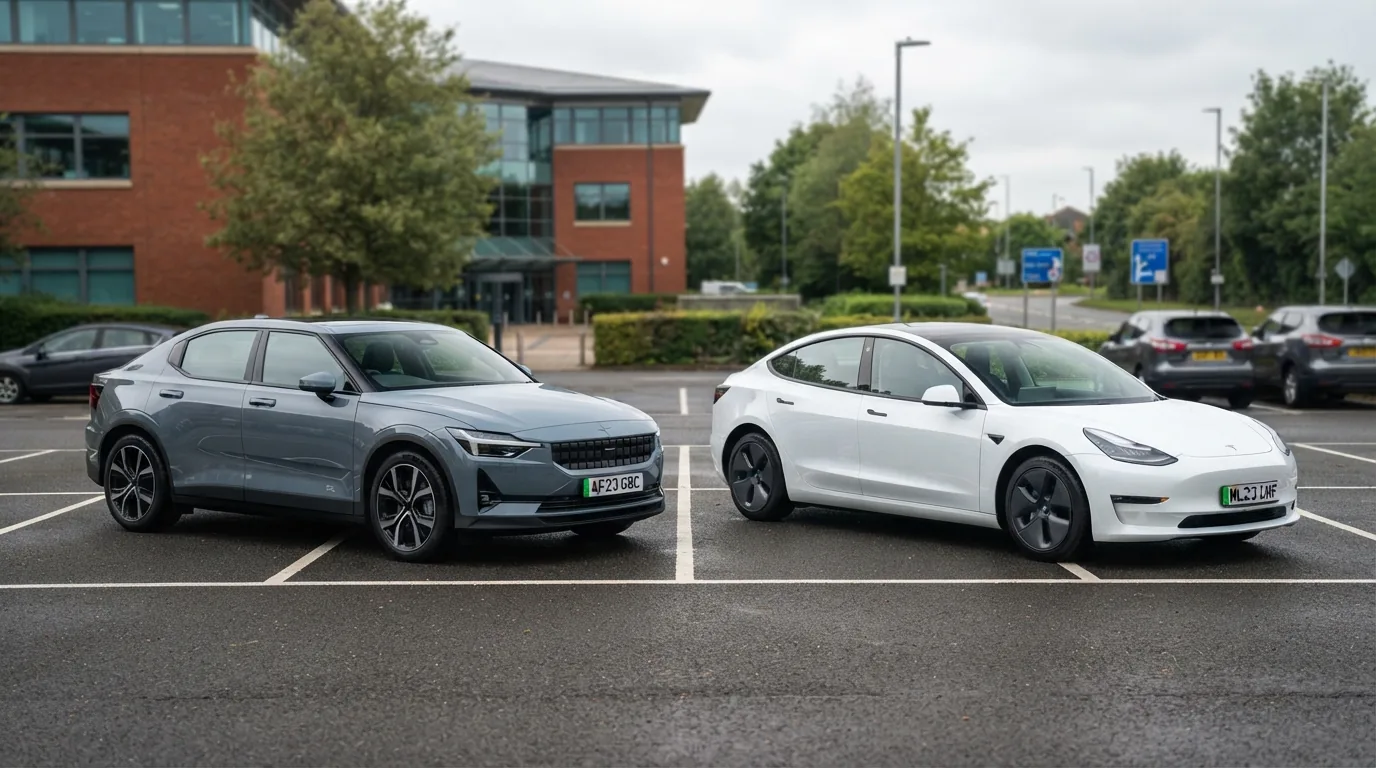
Quick answers
- The Polestar 2 and Tesla Model 3 are the two most directly comparable premium electric saloon/fastbacks in the UK company car market. Both attract the 4% BIK rate in 2026/27.
- Head-to-head specification table: BIK figures based on 4% rate for zero-emission cars in 2026/27.
- Range: Tesla Model 3 Long Range leads: The Model 3 Long Range's 436-mile WLTP is the headline figure, but what matters for business use is real-world motorway range.
- The Model 3 LR charges at up to 250kW on a Tesla Supercharger, reaching 10–80% in approximately 23 minutes.
- Interior: Polestar 2 wins clearly: The Tesla Model 3's interior has been updated since 2024 and is now significantly better than the early versions.
- Because the Polestar 2 Long Range has a higher P11D (£48,950) than the Model 3 Long Range (£45,990), the annual BIK charge for a 40% taxpayer is £783 versus £736.
The Polestar 2 and Tesla Model 3 are the two most directly comparable premium electric saloon/fastbacks in the UK company car market. Both attract the 4% BIK rate in 2026/27. Both offer over 400 miles of WLTP range in their longest-range variants. Both are available through salary sacrifice. Our verdict: the Tesla Model 3 Long Range is the better company car for the majority of UK business drivers, primarily because of its 30-mile range advantage at motorway speed, faster charging on the Supercharger network, and lower effective monthly cost. The Polestar 2 wins on driving character, interior feel, and the appeal of a less ubiquitous badge. Neither choice is wrong, but they suit different drivers.
Head-to-head specification table
| Tesla Model 3 Standard Range | Tesla Model 3 Long Range | Polestar 2 Std Range | Polestar 2 Long Range | |
|---|---|---|---|---|
| P11D from | ~£40,000 | ~£45,990 | ~£41,700 | ~£48,950 |
| WLTP range | 305 miles | 436 miles | 344 miles | 407 miles |
| Real-world (motorway) | ~240 miles | ~340–360 miles | ~265 miles | ~310–330 miles |
| Battery | 60kWh | 75kWh | 70kWh | 82kWh |
| Peak DC charging | 170kW | 250kW | 205kW | 205kW |
| 10–80% charge time | ~26 min | ~23 min | ~28 min | ~28 min |
| Boot space | 594 litres | 594 litres | 405 litres | 405 litres |
| Annual BIK (40%) | £640 | £736 | £667 | £783 |
| Monthly BIK (40%) | £53 | £61 | £56 | £65 |
| Charging network | Supercharger + public | Supercharger + public | Public | Public |
BIK figures based on 4% rate for zero-emission cars in 2026/27.
Range: Tesla Model 3 Long Range leads
The Model 3 Long Range’s 436-mile WLTP is the headline figure, but what matters for business use is real-world motorway range. At 70 mph, the Model 3 LR delivers approximately 340–360 miles. The Polestar 2 Long Range manages around 310–330 miles at the same speed. That 30-mile gap is meaningful on a long business day: a driver going from London to Edinburgh (approximately 400 miles) might need one charging stop in the Model 3 and a slightly longer or earlier stop in the Polestar.
At equal specification (comparing standard range to standard range), the Polestar 2’s 344-mile WLTP is strong against the Model 3’s 305-mile figure. The gap narrows when you are not comparing top-of-range variants.
Charging: Tesla Supercharger network is a genuine advantage
The Model 3 LR charges at up to 250kW on a Tesla Supercharger, reaching 10–80% in approximately 23 minutes. The Polestar 2 peaks at 205kW on compatible public chargers, with a 10–80% time of around 28 minutes.
The speed difference is small. The network difference is more significant. Tesla’s Supercharger network has over 1,500 UK locations, all consistently fast, most located at convenient service stations or retail parks, with pricing visible before you plug in. The Polestar 2 uses the public CCS network (Gridserve, BP Pulse, Osprey, Osprey and others), which is improving but remains less uniform in reliability and pricing.
Polestar has added Supercharger compatibility, so Polestar 2 drivers can now access Tesla Superchargers via the Plugshare app or credit card. The experience is functional but not as seamlessly integrated as the native Tesla routing and billing.
Interior: Polestar 2 wins clearly
This is where the Polestar 2 makes its clearest case. The interior is built to a higher perceived quality standard: more convincing soft-touch materials, clearer physical controls for heating and ventilation (which many drivers strongly prefer to a touchscreen-only approach), and a Google-powered infotainment system that is intuitive and capable.
The Tesla Model 3’s interior has been updated since 2024 and is now significantly better than the early versions. But the Polestar 2 still feels more solidly European in construction, and its Harman Kardon audio system (standard on higher trims) is genuinely excellent.
Boot space favours the Model 3 significantly: 594 litres versus the Polestar’s 405 litres. For business drivers who carry equipment, samples or regular luggage, this difference has practical weight. The Model 3 also has a front trunk (frunk) that adds modest additional storage.
BIK costs: similar but Polestar 2 LR is slightly higher
Because the Polestar 2 Long Range has a higher P11D (£48,950) than the Model 3 Long Range (£45,990), the annual BIK charge for a 40% taxpayer is £783 versus £736. The monthly difference is £65 versus £61. Over three years, the Polestar costs £141 more in BIK tax, which is negligible in the overall picture but worth noting.
Both cars are dramatically cheaper than any petrol equivalent. A BMW 3 Series diesel at a similar list price would cost a 40% taxpayer around £400 per month in BIK alone.
Company car tax comparison over 3 years (40% taxpayer)
| Model 3 LR | Polestar 2 LR | |
|---|---|---|
| Annual BIK | £736 | £783 |
| 3-year BIK total | £2,208 | £2,349 |
| Difference | , | +£141 |
| Monthly BIK | £61 | £65 |
The 3-year difference is £141, which is genuinely inconsequential. Company car choice should not hinge on this.
Salary sacrifice: which is more popular?
In terms of salary sacrifice popularity, the Tesla Model 3 edges ahead, largely because of its longer range and Supercharger network giving greater operational confidence for drivers unfamiliar with EV logistics. However, the Polestar 2 has built a loyal following among salary sacrifice drivers who value driving character and interior quality over network advantage.
Both cars are widely available through UK salary sacrifice providers. Monthly sacrifice costs are similar, with the Polestar 2 LR typically running £10–£20 per month more than the Model 3 LR due to its higher lease cost.
Driving experience: Polestar leads
For drivers who care about how the car feels, the Polestar 2 is the more engaging choice. Its suspension is tuned for a blend of firmness and compliance that suits twisty A-roads as well as motorways. Steering is direct and communicative. At motorway speeds, the Polestar is noticeably quieter than the Model 3, with better wind and road noise suppression.
The Model 3 is not a bad drive. It is composed and capable, particularly with the recent ride quality improvements. But for drivers who come from a BMW 3 Series or Volvo V60 and expect a specific kind of premium driving feel, the Polestar 2 is the closer match.
Which should you choose?
Choose the Tesla Model 3 Long Range if:
- Range and Supercharger network access are your priority
- You carry luggage or equipment and need the larger boot
- You want the lowest possible monthly BIK charge among the two
- You do a lot of long motorway driving and want the most range buffer
Choose the Polestar 2 Long Range if:
- Interior quality and physical controls matter to you
- You drive more A-road and mixed routes than pure motorway
- You want a different badge from the increasingly common Tesla
- Driving engagement is a factor in your company car choice
Our verdict
For a pure business case, the Tesla Model 3 Long Range has the edge: more range at motorway speed, faster Supercharger access, and a larger boot. For a driver who values the experience inside and behind the wheel, the Polestar 2 Long Range is the more satisfying car. The BIK cost difference is trivial. Both are among the best company cars available in any category in 2026.
For context on how both cars sit within salary sacrifice and fleet arrangements, see our company cars and fleet guide. For more models across the full range, visit our best electric cars for salary sacrifice page.
How we test and where our numbers come from
Range figures are official WLTP combined values taken from manufacturer UK specification pages, with real-world estimates drawn from independent comparative testing. Prices are UK list prices at the time of the latest update. Tax, grant and charging-scheme figures come from GOV.UK and HMRC publications. We re-check every guide when pricing, specification or policy changes. Last checked 11 August 2026.
Frequently asked questions
Salary sacrifice: which is more popular?
In terms of salary sacrifice popularity, the Tesla Model 3 edges ahead, largely because of its longer range and Supercharger network giving greater operational confidence for drivers unfamiliar with EV logistics.
Sources and further reading
- gov.ukHMRCPrimary source referenced in this article.

EV Compared
The EV Compared editorial team tracks the UK electric vehicle market full time: new model launches, list prices, WLTP and real-world range, public charging tariffs and the tax rules that decide what an EV actually costs to run. Every guide is checked against manufacturer specifications and official GOV.UK figures, and updated whenever the numbers move.
Related reading
View all
What Does the 2030 Petrol and Diesel Ban Actually Mean?
Separating the facts from the myths: what changes in 2030, what does not, and what it means for your next car
Best Affordable EVs Under the Electric Car Grant
The electric cars that combine a government grant with the lowest purchase prices in the UK market right now

What Is the Benefit in Kind Rate for Electric Cars?
The electric car BiK rate is 4% for 2026/27, rising to 9% by 2029/30 on a confirmed schedule. Here is what that means for your tax bill, with worked examples and a full multi-year projection.