How Do Electric Car Fleet Schemes Work in the UK?
Business Contract Hire, salary sacrifice and ECO schemes explained for 2026
Quick answers
- UK businesses access electric cars for their employees through three main fleet scheme types: Business Contract Hire (BCH), where the company leases and provides the cars; salary sacrifice, where employees fund their own car from pre-tax salary; and Employee Car Ownership (ECO) schemes.
- Under BCH, your company leases vehicles directly from a leasing company or fleet management provider.
- This is currently the fastest-growing fleet scheme in the UK.
- Employee Car Ownership (ECO) schemes: ECO avoids BIK because the employee owns the car, not the employer.
- From 2026, the Zero Emission Vehicle Mandate requires 22% of new cars sold by each manufacturer to be zero-emission (rising each year).
- The biggest operational challenge for EV fleets is charging.
UK businesses access electric cars for their employees through three main fleet scheme types: Business Contract Hire (BCH), where the company leases and provides the cars; salary sacrifice, where employees fund their own car from pre-tax salary; and Employee Car Ownership (ECO) schemes. Each has different tax implications, risks and advantages. The right choice depends on company size, how much tax the employer wants to manage, and whether the business wants to carry the residual value risk. According to BVRLA data published in early 2026, salary sacrifice arrangements have grown 118% year on year, now representing over 400,000 battery electric vehicles on its member fleets.
Business Contract Hire (BCH): the employer funds the fleet
Under BCH, your company leases vehicles directly from a leasing company or fleet management provider. The employer provides the cars to employees. The employee pays Benefit-in-Kind (BIK) tax on the car as a company car benefit. With electric vehicles, the BIK rate is just 4% in 2026/27, which keeps employee tax costs low.
For the employer, the key financial points are:
Lease payments as a business expense. Monthly rental payments are deductible against corporation tax, subject to a restriction for high-CO2 vehicles. Zero-emission cars face no restriction, so 100% of the rental is deductible.
VAT recovery. If the car is available for private use (which is normal for company cars), only 50% of the VAT on the monthly rental is recoverable. If the car is restricted to business use only, 100% of VAT is recoverable.
First Year Allowance. If the company buys rather than leases, a 100% FYA is available on new zero-emission cars until April 2027. On a £40,000 car, a company paying 25% corporation tax saves £10,000 in the first year.
Employer Class 1A NI. The employer pays 15% NI on the BIK value. For a £40,000 EV at 4% BIK, the BIK value is £1,600, so the employer NI charge is £240 per year per car. Compare that with a petrol equivalent at 30% BIK: the BIK value is £12,000, and the employer NI charge is £1,800.
The leasing company carries the residual value risk under BCH, which matters in the EV market where used values have been volatile.
Salary sacrifice: employees fund cars from gross salary
Salary sacrifice is fundamentally different from BCH. The employer still leases the car, but employees agree to reduce their gross salary in exchange for use of the vehicle. The deduction comes from pre-tax income, so the employee saves income tax and National Insurance on the amount sacrificed.
This is currently the fastest-growing fleet scheme in the UK. The combination of the low 4% EV BIK rate and the income tax/NI saving on sacrificed salary can reduce an employee’s effective monthly motoring cost by 30–50% compared with a personal lease.
How the employer benefits. When employees sacrifice salary, the employer’s NI bill falls. At 15% employer NI, a £6,000 annual sacrifice reduces the employer’s NI liability by £900 per employee. For many businesses, this saving effectively funds the administration cost of running the scheme, making it free to operate.
How the employee benefits. A basic-rate (20%) taxpayer sacrificing £500 per month saves approximately £140 in income tax and NI each month. A higher-rate (40%) taxpayer saves approximately £210 per month on the same sacrifice.
Who runs the scheme. Most businesses partner with a specialist salary sacrifice provider such as Octopus EV, Tusker, Fleet Alliance, or similar. The provider manages vehicle sourcing, leasing, insurance (in many cases), maintenance, and contract administration. The employer’s HR team handles the payroll entry and contract variation.
Key constraint. Salary sacrifice cannot reduce an employee’s cash pay below the National Minimum Wage. For lower-paid staff, the full lease cost may not be sacrificeable.
Employee Car Ownership (ECO) schemes
ECO schemes are less common but worth knowing about. Under this approach, the employer provides an interest-free or low-interest loan that the employee uses to purchase a car personally. The car belongs to the employee from day one.
ECO avoids BIK because the employee owns the car, not the employer. However, the employer must ensure the loan itself does not create a taxable benefit (loans up to £10,000 are exempt from BIK under HMRC rules). ECO suits businesses that want to offer a car benefit without the administrative burden of fleet management.
Comparison of fleet scheme types
| Factor | BCH (company car) | Salary sacrifice | ECO |
|---|---|---|---|
| Who leases/owns the car | Employer | Employer | Employee |
| BIK rate (EV, 2026/27) | 4% | 4% | N/A |
| Employee income tax saving | No | Yes (on sacrifice) | No |
| Employee NI saving | No | Yes (on sacrifice) | No |
| Employer NI saving | No | Yes | Possible |
| Residual value risk | Leasing company | Leasing company | Employee |
| Minimum wage constraint | No | Yes | No |
| Employer admin burden | Medium | Low (with provider) | Low |
| Typical employee saving vs PCH | High | Very high | Moderate |
What the ZEV Mandate means for fleet operators
From 2026, the Zero Emission Vehicle Mandate requires 22% of new cars sold by each manufacturer to be zero-emission (rising each year). Manufacturers that miss their targets pay financial penalties. For fleet operators, this means manufacturers are strongly incentivised to offer competitive pricing and terms on their EV ranges. Fleets that commit to electric now tend to get better contract terms than those waiting.
BVRLA data shows more than a third of cars on the UK leasing fleet are now battery electric vehicles, with an average age of just over three years. The infrastructure for managing, servicing and charging large EV fleets is now well-established.
Fleet charging: the infrastructure question
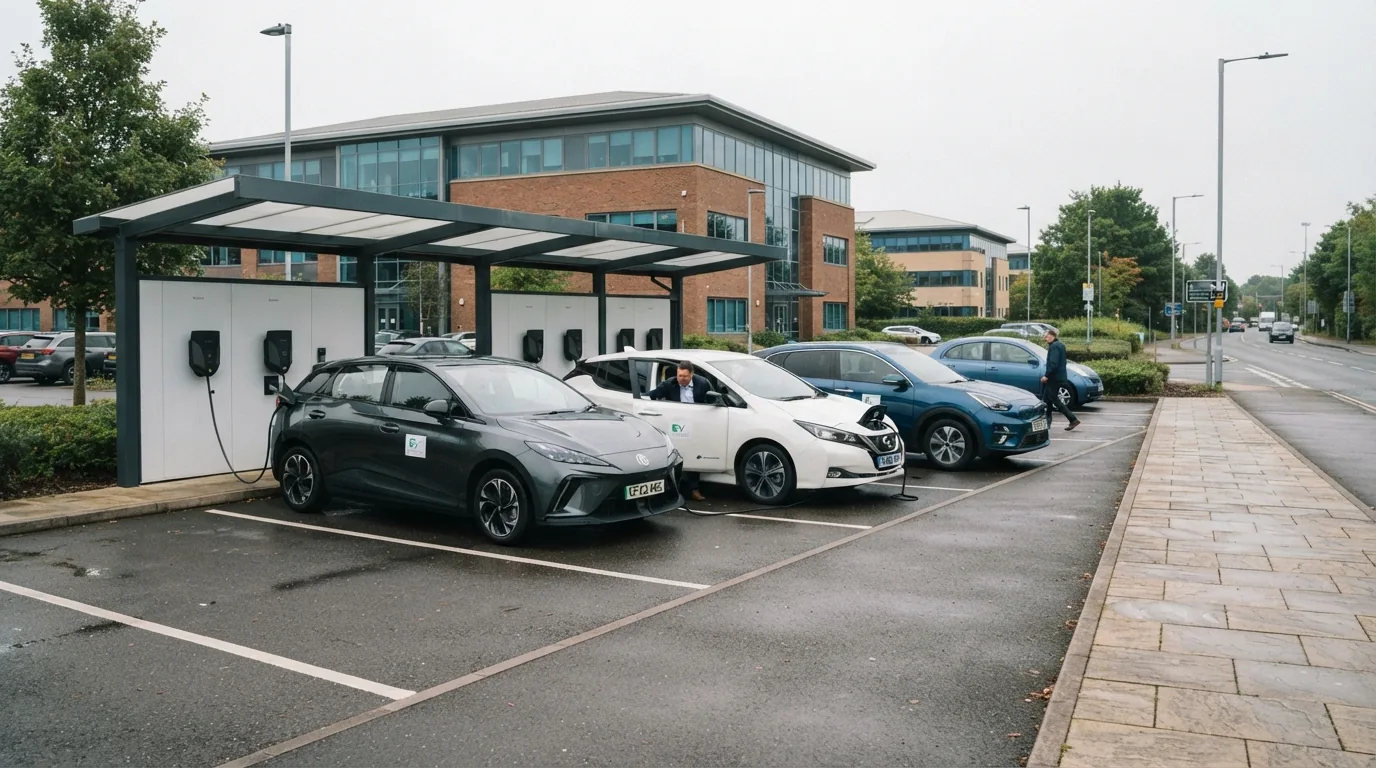
The biggest operational challenge for EV fleets is charging. Most fleet operators adopt a mixed approach:
Workplace charging. Charge points at depots, offices and car parks. The government’s Workplace Charging Scheme (WCS) provides up to £350 per socket, with a cap of 40 sockets per business. Employers who provide free workplace electricity for employee EV charging face no additional BIK charge.
Home charging. Many fleet drivers charge primarily at home. Employers can reimburse home charging at HMRC’s approved rate of 10p per mile for zero-emission cars under the AMAP rules, or pay a mileage rate to cover the cost of electricity used for business travel.
Public network. For high-mileage drivers and those without home charging access, a public charging account (such as through BP Pulse, Pod Point, or Gridserve) on the company’s account is standard practice.
What should you do next?
If you are considering a fleet scheme for your business, the first decision is whether to run a company car scheme (BCH) or a salary sacrifice arrangement. For most businesses with employees across different salary bands, salary sacrifice is the more flexible and financially efficient option. Our company cars and fleet guide covers both routes in detail. To see the best EV models for fleet and salary sacrifice use, visit our best electric cars for salary sacrifice page.
How we test and where our numbers come from
Range figures are official WLTP combined values taken from manufacturer UK specification pages, with real-world estimates drawn from independent comparative testing. Prices are UK list prices at the time of the latest update. Tax, grant and charging-scheme figures come from GOV.UK and HMRC publications. We re-check every guide when pricing, specification or policy changes. Last checked 11 August 2026.
Sources and further reading
- bvrla.co.ukBVRLAPrimary source referenced in this article.

EV Compared
The EV Compared editorial team tracks the UK electric vehicle market full time: new model launches, list prices, WLTP and real-world range, public charging tariffs and the tax rules that decide what an EV actually costs to run. Every guide is checked against manufacturer specifications and official GOV.UK figures, and updated whenever the numbers move.
Related reading
View all
What Does the 2030 Petrol and Diesel Ban Actually Mean?
Separating the facts from the myths: what changes in 2030, what does not, and what it means for your next car

Best Affordable EVs Under the Electric Car Grant
The electric cars that combine a government grant with the lowest purchase prices in the UK market right now

What Is the Benefit in Kind Rate for Electric Cars?
The electric car BiK rate is 4% for 2026/27, rising to 9% by 2029/30 on a confirmed schedule. Here is what that means for your tax bill, with worked examples and a full multi-year projection.