Best Electric Cars for High Mileage Business Drivers
Top EVs for 20,000+ miles per year: range, charging speed and real-world usability ranked
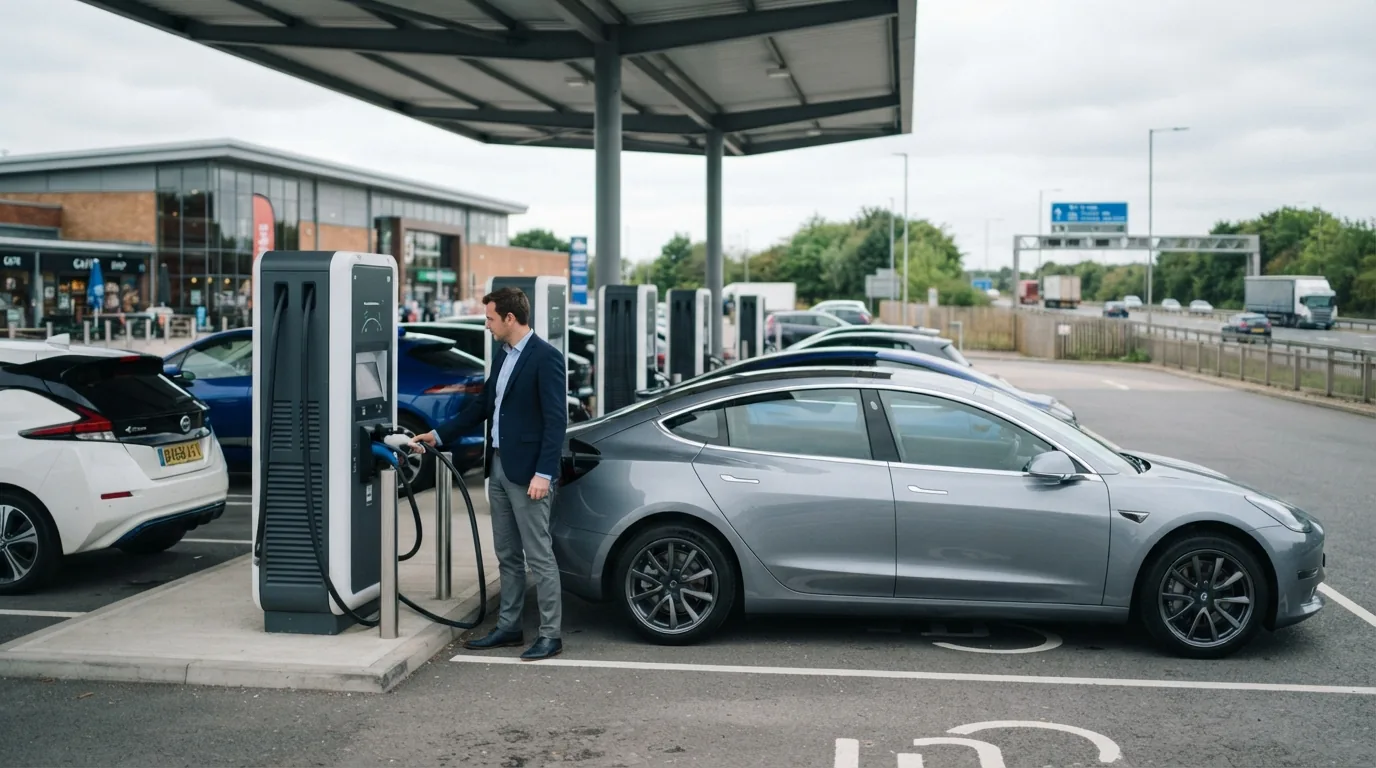
Quick answers
- For high-mileage business drivers covering 20,000–40,000 miles per year, the choice of electric car matters far more than it does for a low-mileage commuter.
- The Model 3 Long Range is the most operationally effective high-mileage company car in 2026.
- The Audi A6 e-tron delivers 470 miles WLTP and, critically, 270kW peak DC charging: the fastest in its class on the public network.
- 3. Mercedes EQS: best for maximum range: The EQS 450+ offers 511 miles WLTP, the longest range of any production electric car on sale in the UK.
- 4. BMW iX3: new long-range benchmark: The new BMW iX3, based on the Neue Klasse platform and arriving in 2026, offers a headline WLTP range of approximately 500 miles.
- The ID.7 is specifically designed with long-distance driving in mind.
For high-mileage business drivers covering 20,000–40,000 miles per year, the choice of electric car matters far more than it does for a low-mileage commuter. Range, real-world efficiency at motorway speed, charging speed, and the reliability of the UK public charging network all become critical factors. The BIK advantage of a fully electric company car in 2026/27 (4% versus 25–37% for petrol) holds at any mileage, but the operational case for a specific model lives or dies on whether it can handle the day-to-day reality of sustained high-mileage driving.
This page ranks the best electric cars for UK business drivers covering high annual mileage, based on WLTP range, real-world motorway efficiency, DC charging speed, and total cost over a three-year period.
What high-mileage drivers need
Before the rankings, it is worth setting out what separates a good high-mileage EV from a merely good EV:
Range. At motorway speeds, real-world range is typically 20–30% below WLTP. A car with 400 miles WLTP delivers around 280–320 miles at 70 mph. For a driver covering 300 miles in a day, that means one charging stop, which is manageable. A car with 250 miles WLTP at motorway speeds becomes two stops in a long day, which disrupts schedules.
Charging speed. A 200kW+ DC capability means 10–80% in 20–25 minutes. At 100kW, the same top-up takes 40–50 minutes. Over 200 motorway stops a year, the difference in time lost is significant.
Network coverage. Access to the Tesla Supercharger network (1,500+ UK locations, typically reliable) or the Ionity/Osprey/Gridserve rapid network matters enormously for routes that cross the UK. A car with 400 miles WLTP but access only to slower or patchy public chargers is a harder proposition than a car with 350 miles WLTP and a premium charging network.
Efficiency at speed. Cars that are efficient at 70 mph stretch their usable range dramatically. The Tesla Model 3 achieves around 3.5 miles/kWh at motorway speed. Some larger EVs drop to 2.5 miles/kWh or below, dramatically reducing the real-world range from the WLTP headline.
Full comparison: top EVs for high-mileage business drivers
| Model | WLTP range | Real-world (motorway) | Peak DC | Network access | P11D from | BIK/month (40%) |
|---|---|---|---|---|---|---|
| Tesla Model 3 LR | 436 miles | ~340–360 miles | 250kW | Supercharger | £45,990 | £61 |
| Mercedes EQS 450+ | 511 miles | ~400–425 miles | 200kW | Public | £105,000+ | £140 |
| BMW iX3 | ~500 miles | ~375 miles | 230kW | Public | TBC ~£60,000 | £80 |
| Audi A6 e-tron | 470 miles | ~370 miles | 270kW | Public | ~£60,000 | £80 |
| Polestar 2 LR | 407 miles | ~310–330 miles | 205kW | Public | £48,950 | £65 |
| Hyundai Ioniq 6 RWD | 338 miles | ~270–290 miles | 239kW | Public | £42,995 | £57 |
| Kia EV6 | 381 miles | ~300 miles | 238kW | Public | £40,895 | £55 |
| Mercedes CLA Electric | 400+ miles | ~350+ miles | 200kW+ | Public | ~£45,000 | £60 |
| Volkswagen ID.7 | 382 miles | ~300 miles | 200kW | Public | £50,250 | £67 |
1. Tesla Model 3 Long Range: best overall for high-mileage drivers
The Model 3 Long Range is the most operationally effective high-mileage company car in 2026. Here is why:
The 436-mile WLTP figure translates to approximately 340–360 real-world miles at motorway speed, thanks to exceptional efficiency of around 3.5 miles/kWh. The Supercharger network delivers 250kW peak charging, meaning a 10–80% top-up takes around 23 minutes on a compatible charger. With over 1,500 UK Supercharger locations, coverage is excellent across motorway corridors and major routes.
For a business driver covering 30,000 miles per year, the fuel cost on home charging (at 7p/kWh overnight) is approximately £600–£900 per year. A petrol equivalent at 40mpg and current prices would cost £4,500–£5,500. The annual saving on fuel alone is £3,500–£4,500 per car.
The P11D of £45,990 means a 40% taxpayer pays £61 per month in BIK. On a diesel 3 Series at £42,000 and 31% BIK, the same driver pays over £400 per month.
Verdict: The default recommendation for any high-mileage business driver who wants the strongest combination of range, charging network and efficiency. The Supercharger network advantage is genuine and differentiating.
2. Audi A6 e-tron: best for rapid charging on public network
The Audi A6 e-tron delivers 470 miles WLTP and, critically, 270kW peak DC charging: the fastest in its class on the public network. At 270kW on a compatible charger, 10–80% takes approximately 20 minutes. For drivers whose routes rely on the public rapid charging network rather than Tesla Superchargers, this is the fastest charging experience available.
Real-world range at motorway speeds is around 370 miles. The A6 e-tron’s efficiency at speed is strong relative to its size, aided by the long wheelbase and optimised aerodynamics. The interior is genuinely executive quality, making it appropriate for senior and client-facing roles.
Verdict: Best for high-mileage executives who need fast public charging and premium interior quality.
3. Mercedes EQS: best for maximum range
The EQS 450+ offers 511 miles WLTP, the longest range of any production electric car on sale in the UK. Real-world motorway figures of 400+ miles are achievable in mild conditions, making it the only car that can realistically cover 400+ miles in a single session without a charging stop. For chauffeurs, C-suite executives, and high-mileage drivers on very long routes, this is an unmatched proposition.
The price is high (P11D from around £105,000), but the BIK at 4% still produces a monthly tax charge of approximately £140 for a 40% taxpayer. On a comparable petrol S-Class at 37% BIK and a similar list price, the BIK charge would be over £1,500 per month.
Verdict: For senior executives and chauffeur operators where maximum range and S-Class refinement are non-negotiable.
4. BMW iX3: new long-range benchmark
The new BMW iX3, based on the Neue Klasse platform and arriving in 2026, offers a headline WLTP range of approximately 500 miles. Real-world motorway figures of around 375 miles are expected. DC charging peaks at 230kW. For high-mileage BMW company car drivers who need the BMW badge and want the strongest possible range, the iX3 is the most significant new arrival of 2026.
Verdict: The most anticipated BMW for high-mileage company drivers; watch pricing as it is confirmed.
5. Volkswagen ID.7: best for field sales and regional managers
The ID.7 is specifically designed with long-distance driving in mind. Its 382-mile WLTP range, 200kW DC charging, 605-litre boot, and composed motorway ride make it ideal for regional managers and field sales professionals who spend four to five hours per day on the road. The ID.7 does not have the driver engagement of the Tesla or Polestar, but its comfort, noise levels and interior quality are strong for extended daily use.
Verdict: Best for drivers who want comfort over driving enjoyment on motorway-dominated routes.
6. Mercedes CLA Electric: best new entrant for 2026
The CLA Electric has surprised reviewers with over 400 miles of real-world range and charging speeds that keep journey times competitive. For high-mileage drivers who want an executive saloon rather than an SUV, it is the most significant new model of 2026 and challenges the Tesla Model 3 and BMW i4 directly.
Verdict: Watch this space. If production models confirm the pre-launch range claims, it becomes the top choice in the executive saloon category.
The mileage allowance for company drivers
High-mileage company car drivers should also be aware of the Advisory Electric Rate (AER) for business mileage reimbursement. HMRC’s AER for electric cars is currently 7p per mile. If you charge at the office and your employer does not reimburse your electricity costs, you can claim 7p per mile for business journeys on your Self Assessment return.
If you have your own car and are reimbursed business mileage by your employer (rather than having a company car), you can claim the Approved Mileage Allowance Payment of 45p per mile for the first 10,000 business miles and 25p thereafter, regardless of fuel type.
What should you do next?
For context on company car tax, BIK and salary sacrifice, see our company cars and fleet guide. For the full range of models for salary sacrifice including lower-mileage options, visit our best electric cars for salary sacrifice page.
How we test and where our numbers come from
Range figures are official WLTP combined values taken from manufacturer UK specification pages, with real-world estimates drawn from independent comparative testing. Prices are UK list prices at the time of the latest update. Tax, grant and charging-scheme figures come from GOV.UK and HMRC publications. We re-check every guide when pricing, specification or policy changes. Last checked 11 August 2026.
Sources and further reading
- bvrla.co.ukBVRLAPrimary source referenced in this article.

EV Compared
The EV Compared editorial team tracks the UK electric vehicle market full time: new model launches, list prices, WLTP and real-world range, public charging tariffs and the tax rules that decide what an EV actually costs to run. Every guide is checked against manufacturer specifications and official GOV.UK figures, and updated whenever the numbers move.
Related reading
View all
What Does the 2030 Petrol and Diesel Ban Actually Mean?
Separating the facts from the myths: what changes in 2030, what does not, and what it means for your next car
Best Affordable EVs Under the Electric Car Grant
The electric cars that combine a government grant with the lowest purchase prices in the UK market right now

What Is the Benefit in Kind Rate for Electric Cars?
The electric car BiK rate is 4% for 2026/27, rising to 9% by 2029/30 on a confirmed schedule. Here is what that means for your tax bill, with worked examples and a full multi-year projection.