Best Electric Cars for Business Use in the UK
Top EVs for company drivers, sole traders and fleet buyers in 2026, ranked by value and usability
Quick answers
- The best electric cars for business use in the UK in 2026 are those that combine genuine long-distance range, rapid charging capability, low running costs and a BIK tax bill that makes sense for both the employer and the employee.
- The Model 3 Long Range remains the benchmark for business drivers in 2026.
The best electric cars for business use in the UK in 2026 are those that combine genuine long-distance range, rapid charging capability, low running costs and a BIK tax bill that makes sense for both the employer and the employee. The Benefit-in-Kind rate for fully electric cars is 4% in 2026/27, compared with 25–37% for petrol and diesel. That means the tax case for a business EV is strong regardless of the car’s price. The question is which model best fits the type of driving, the mileage, and the budget.
What makes a good business electric car?
Business drivers have different priorities from private buyers:
- Range and charging. High-mileage drivers need cars that can cover long distances and charge quickly on the UK public network. For executives covering 20,000+ miles per year, a 300-mile minimum WLTP range and 200kW+ DC charging are important.
- Running costs. Company drivers and fleet managers want low total cost of ownership. EVs are cheaper per mile than petrol (around 2–4p/mile on home charging versus 15–18p for petrol), and servicing costs are lower.
- BIK efficiency. The BIK rate is the same for all EVs, but a lower P11D value reduces the absolute BIK bill. For employees, this affects take-home pay.
- Practicality. Boot space, comfort, technology, and whether the car suits the role (executive, sales, technical).
Top 8 electric cars for business use in 2026
1. Tesla Model 3 Long Range: best overall for high-mileage business use
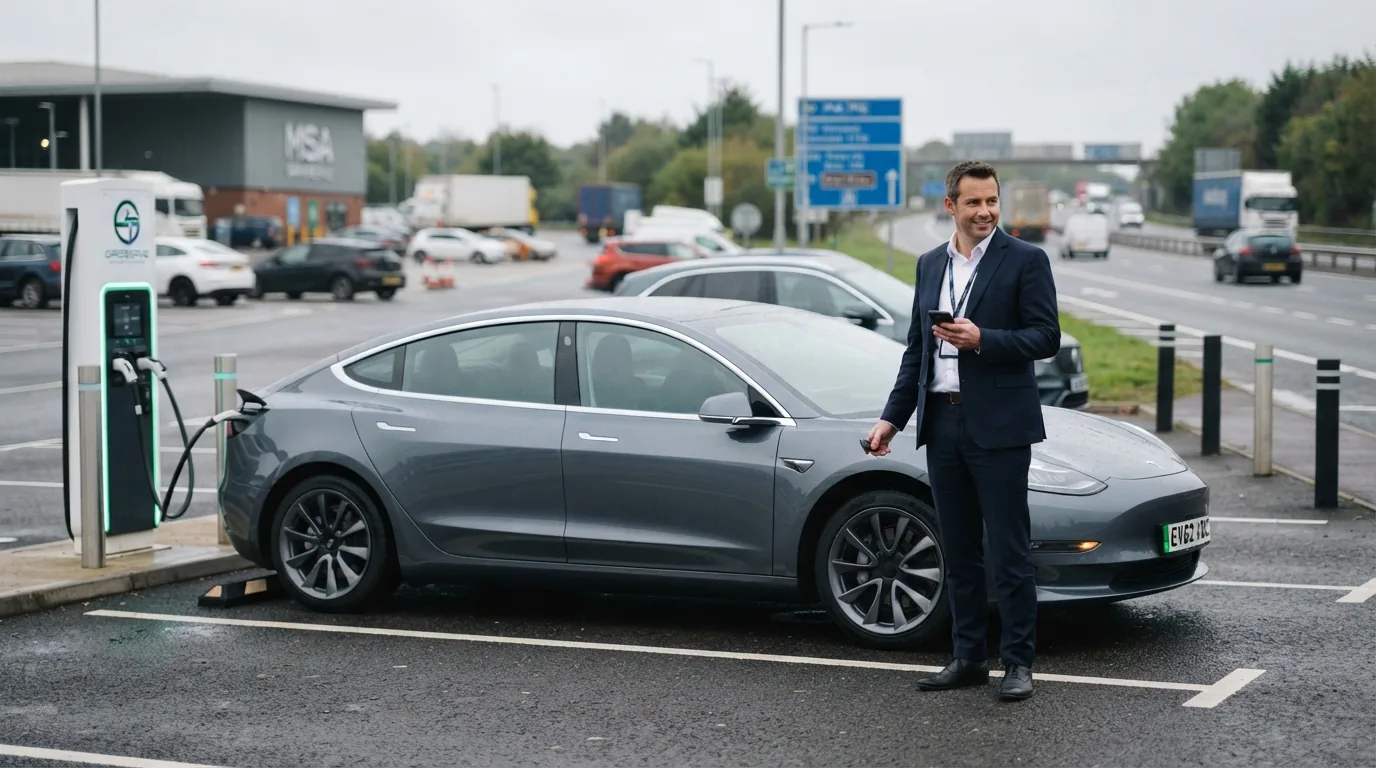
The Model 3 Long Range remains the benchmark for business drivers in 2026. It delivers 436 miles WLTP (real-world figures of around 340–380 miles at motorway speeds), charges at up to 250kW on a Supercharger (10–80% in under 25 minutes), and costs significantly less in tax than any petrol equivalent.
For high-mileage drivers covering 25,000–40,000 miles per year, the combination of range, charging network coverage, and efficiency at speed is hard to match. The Model 3 achieves around 3.5 miles/kWh at motorway speeds, which is class-leading.
P11D from: £45,990 | BIK (40%, 2026/27): £61/month | WLTP range: 436 miles
2. Mercedes-Benz CLA Electric: best executive business car
The new Mercedes CLA Electric, launched in 2026, combines over 400 miles of real-world range with S-Class levels of cabin quality and technology. Early reviews rate it as the most complete executive EV for business users, ahead of the BMW i4 and Audi A4 e-tron it replaces as the reference point for premium company car drivers.
Charging is rapid, build quality is excellent, and Mercedes’s established dealer network provides the servicing reliability that fleet operators need.
P11D from: approx. £45,000 | BIK (40%, 2026/27): ~£60/month | Real-world range: 400+ miles
3. BMW i4 eDrive40: best premium driving experience for business
The BMW i4 has been the default choice for executives moving from diesel 3 Series or 4 Series company cars. The eDrive40 offers 365 miles WLTP, 205kW DC charging, and an interior that feels authentically BMW. It was the preferred company car EV for senior managers before the CLA Electric arrived, and it remains a strong choice.
P11D from: £53,900 | BIK (40%, 2026/27): £72/month | WLTP range: 365 miles
4. Volkswagen ID.7: best for long-distance sales reps
The ID.7 is designed explicitly for motorway drivers. Up to 382 miles WLTP, 200kW DC charging, a large 605-litre boot, and a comfortable motorway ride make it well-suited to high-mileage field sales or territory management roles. VW reliability and the established dealer network add peace of mind for fleet managers.
P11D from: £50,250 | BIK (40%, 2026/27): £67/month | WLTP range: 382 miles
5. Kia EV6: best value premium business car
The EV6’s 800V architecture enables 238kW peak DC charging (10–80% in 18 minutes), which is critical for business drivers who cannot afford long charging stops. Range is up to 381 miles WLTP. The EV6 costs less than BMW, Mercedes or Audi equivalents but offers comparable real-world capability. Kia’s seven-year warranty is the longest in class and reduces residual value risk for fleet managers.
P11D from: £40,895 | BIK (40%, 2026/27): £55/month | WLTP range: 381 miles (AWD: 314 miles)
6. Hyundai Ioniq 6: best efficiency for fleet cost management
The Ioniq 6’s efficiency at motorway speed is exceptional, typically achieving 3.5–4.0 miles/kWh at 70 mph. For a fleet where drivers pay for their own fuel between reimbursement cycles, this translates directly to lower out-of-pocket costs. 800V charging at 239kW is class-leading. Range is 338 miles WLTP on the standard RWD version.
P11D from: £42,995 | BIK (40%, 2026/27): £57/month | WLTP range: 338 miles
7. Polestar 2: best for driver satisfaction and retention
Business drivers do not sacrifice job satisfaction, and the Polestar 2 is genuinely enjoyable to drive. Direct steering, a refined suspension, and a high-quality interior (Harman Kardon audio standard on higher trims) make it a car that company drivers actively want. The Single Motor variant offers 407 miles WLTP from its 82kWh battery.
For businesses that see company car choice as part of their benefits package, the Polestar 2 is a genuine differentiator.
P11D from: £48,950 | BIK (40%, 2026/27): £65/month | WLTP range: 407 miles
8. MG4: best budget business EV
For businesses that need to deploy EVs across a wide workforce at the lowest possible cost, the MG4 remains unmatched. P11D values start below £30,000. The SE Long Range offers 323 miles WLTP. Running costs are the lowest in class. BIK is minimal. The MG4 is not an executive car, but for field-based roles, trade use, or large-scale fleet deployment, it makes compelling financial sense.
P11D from: £26,995 | BIK (40%, 2026/27): £36/month | WLTP range: 218–323 miles
Full comparison table
| Model | P11D from | WLTP range | Peak DC charge | BIK/month (40%) | Best for |
|---|---|---|---|---|---|
| Tesla Model 3 LR | £45,990 | 436 miles | 250kW | £61 | High mileage |
| Mercedes CLA Electric | ~£45,000 | 400+ miles | 200kW+ | ~£60 | Executive |
| BMW i4 eDrive40 | £53,900 | 365 miles | 205kW | £72 | Premium brand |
| VW ID.7 | £50,250 | 382 miles | 200kW | £67 | Sales reps |
| Kia EV6 | £40,895 | 381 miles | 238kW | £55 | Value premium |
| Hyundai Ioniq 6 | £42,995 | 338 miles | 239kW | £57 | Fleet efficiency |
| Polestar 2 | £48,950 | 407 miles | 205kW | £65 | Driver satisfaction |
| MG4 | £26,995 | 323 miles | 140kW | £36 | Budget fleet |
What about total cost of ownership?
BIK tax is only one part of business running costs. Fuel savings and servicing reductions are real. A business driver covering 20,000 miles per year saves approximately £2,800 on fuel (based on home charging at 5p/mile versus petrol at 19p/mile at current prices) and around £400–£500 on servicing annually. Over a three-year company car cycle, those combined savings approach £10,000 per vehicle, on top of the BIK tax saving versus petrol.
What should you do next?
For context on how business EVs interact with salary sacrifice and fleet arrangements, visit our company cars and fleet guide. To find the best models specifically for salary sacrifice, including effective monthly costs after tax savings, see our best electric cars for salary sacrifice page.
How we test and where our numbers come from
Range figures are official WLTP combined values taken from manufacturer UK specification pages, with real-world estimates drawn from independent comparative testing. Prices are UK list prices at the time of the latest update. Tax, grant and charging-scheme figures come from GOV.UK and HMRC publications. We re-check every guide when pricing, specification or policy changes. Last checked 11 August 2026.
Frequently asked questions
What about total cost of ownership?
BIK tax is only one part of business running costs. Fuel savings and servicing reductions are real.
Sources and further reading
- bvrla.co.ukBVRLAPrimary source referenced in this article.

EV Compared
The EV Compared editorial team tracks the UK electric vehicle market full time: new model launches, list prices, WLTP and real-world range, public charging tariffs and the tax rules that decide what an EV actually costs to run. Every guide is checked against manufacturer specifications and official GOV.UK figures, and updated whenever the numbers move.
Related reading
View all
What Does the 2030 Petrol and Diesel Ban Actually Mean?
Separating the facts from the myths: what changes in 2030, what does not, and what it means for your next car
Best Affordable EVs Under the Electric Car Grant
The electric cars that combine a government grant with the lowest purchase prices in the UK market right now

What Is the Benefit in Kind Rate for Electric Cars?
The electric car BiK rate is 4% for 2026/27, rising to 9% by 2029/30 on a confirmed schedule. Here is what that means for your tax bill, with worked examples and a full multi-year projection.