Best EVs to Buy Before the 2030 Petrol Ban
The case for switching now, the models worth buying, and what to consider if you want to be ahead of the curve before new ICE sales end
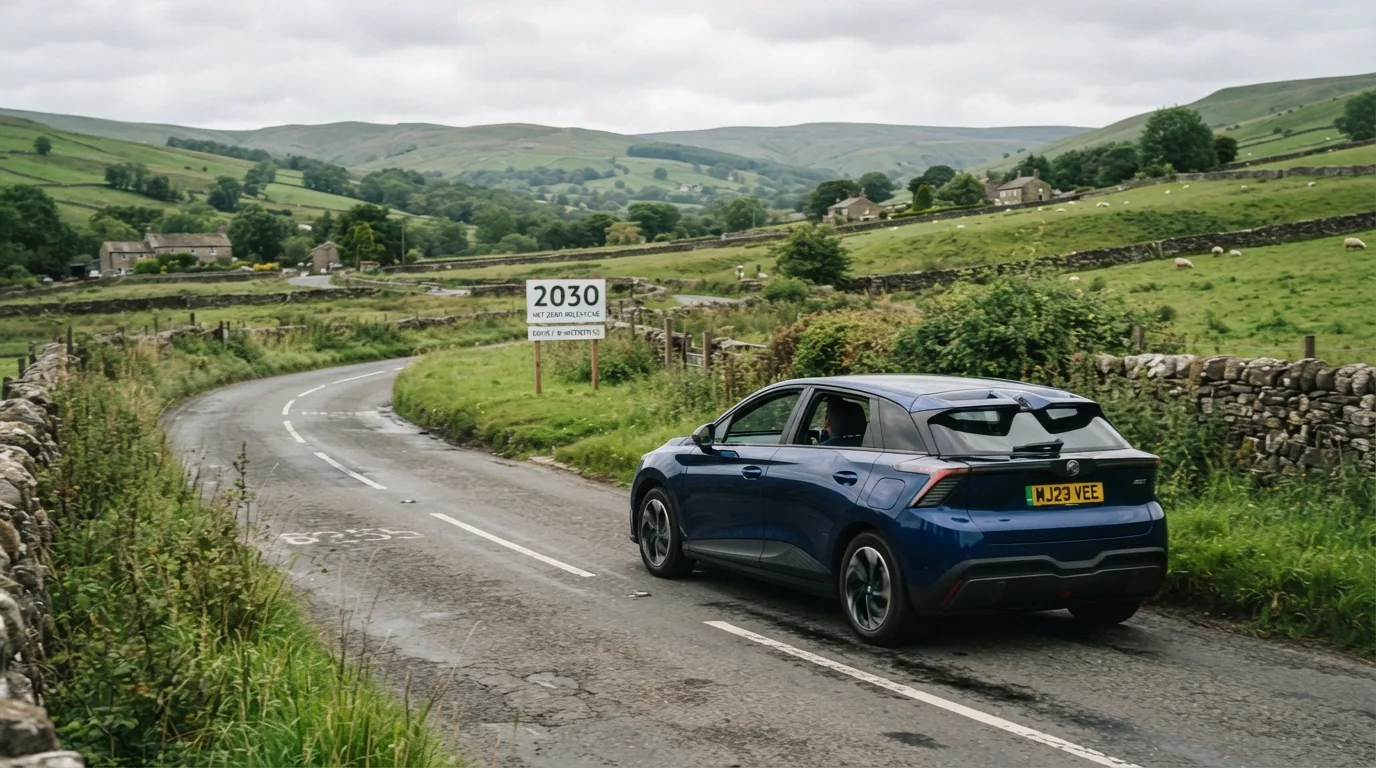
Quick answers
- From 1 January 2030, manufacturers will no longer be able to sell new cars powered solely by petrol or diesel in the UK. You have roughly four years to make a decision: switch to electric now, or wait until closer to the deadline.
- Best EVs to buy now ahead of 2030: The Renault 5 earns the maximum £3,750 Band 1 Electric Car Grant and starts from around £19,250 after grant.
- What about salary sacrifice: For employed buyers, salary sacrifice is the single most powerful route to an affordable EV before 2030.
- Is it too early to buy an EV: The one genuine reason to wait is if you genuinely lack reliable charging access.
From 1 January 2030, manufacturers will no longer be able to sell new cars powered solely by petrol or diesel in the UK. You have roughly four years to make a decision: switch to electric now, or wait until closer to the deadline. The case for switching now is stronger than most people realise. Manufacturer discounts driven by the ZEV Mandate are near their peak, the Electric Car Grant offers up to £3,750 off eligible models, and the charging network is more capable than it has ever been.
Here is why 2026 and 2027 may be the optimal window for switching, and which EVs make the most compelling case for long-term ownership ahead of 2030.
Why buying now makes more sense than waiting
Manufacturer desperation is at maximum. The ZEV Mandate requires 33% of new car registrations to be zero-emission in 2026, rising to 52% in 2028. Manufacturers who miss their targets face fines of £12,000 per non-compliant car. To avoid those fines, they are discounting EVs heavily: in 2025, the average discount on a new EV across the industry was an estimated £11,000. As the market naturally catches up to mandate targets over the next three to four years, that pressure to discount will reduce. The deals available in 2026 will not necessarily be available in 2029.
The Electric Car Grant may not survive until 2030. The current Electric Car Grant is funded to the 2028/29 financial year, with an additional £1.3 billion allocated in the 2025 Budget. However, the scheme can close earlier if the budget is exhausted; the combination of growing EV demand and relatively fixed grant funds means popular models could exhaust their allocation. Waiting until 2029 risks finding no grant available at all.
Charging infrastructure is already good enough. The UK has over 70,000 public chargepoints and a rapidly expanding motorway rapid charging network. For most drivers with access to home or workplace charging, the practical experience of owning an EV in 2026 is materially better than it was in 2020 or 2022.
You lock in four extra years of lower running costs. EVs are significantly cheaper to run than petrol equivalents: electricity at an overnight EV tariff (around 7p to 9p per kWh with Octopus Go or similar) works out at roughly 2p to 3p per mile versus 12p to 15p per mile for petrol. Over 8,000 miles a year, that is a saving of £800 to £1,000 on fuel alone.
What should you look for in a pre-2030 EV?
Strong battery warranty. Minimum 8 years or 100,000 miles on the battery is a requirement for Electric Car Grant eligibility and good practice generally. You want confidence the battery will hold its capacity through the car’s ownership period and beyond.
Future-proof charging speed. A car with at least 50kW DC rapid charging capability is manageable; 100kW or above is significantly better for long-distance journeys. Cars that can only accept 7kW AC are restrictive away from home.
Software update capability over-the-air (OTA). Manufacturers who push regular software updates maintain and improve range, charging behaviour and features without requiring a garage visit.
Proven platform. For a car you intend to own through to 2030 and beyond, a model built on an established platform with multiple years of real-world data is preferable to a first-generation launch vehicle.
Best EVs to buy now ahead of 2030
Renault 5 (52kWh): best value, best grant
The Renault 5 earns the maximum £3,750 Band 1 Electric Car Grant and starts from around £19,250 after grant. Its 52kWh battery delivers 239 miles of WLTP range with proven reliability from the CMF-EV platform. It is compact, practical for urban and suburban use, and represents excellent whole-life value. If you want to switch to electric before the 2030 ban and spend as little as possible, this is the standout starting point.
Grant: £3,750 (Band 1) | After-grant price: from ~£19,250 | Range: 239 miles
Renault 4 (52kWh): best all-round family switch
If you need more space than the Renault 5, the Renault 4 provides a larger boot and more rear legroom with the same 52kWh battery platform, the same Band 1 grant eligibility and 290 miles of WLTP range. At around £23,250 after grant, it undercuts most rival family EVs significantly.
Grant: £3,750 (Band 1) | After-grant price: from ~£23,250 | Range: 290 miles
Volkswagen ID.3: best for mid-range buyers
The ID.3 is a well-sorted, well-supported EV with up to 264 miles of WLTP range and a spacious interior relative to its footprint. With a £1,500 Band 2 grant bringing it to around £31,500, it suits buyers who need a confident, versatile hatchback for a mix of urban, suburban and motorway use. VW’s service network and over-the-air update capability give long-term ownership confidence.
Grant: £1,500 (Band 2) | After-grant price: from ~£31,500 | Range: 264 miles
Citroën e-C5 Aircross: best range for the money
If your concern about switching to EV centres on range anxiety, the e-C5 Aircross addresses it directly with 322 miles of WLTP range. It is in Band 2 (£1,500 grant) and starts from around £32,500 after grant. A comfortable crossover that handles mixed driving well, it suits higher-mileage drivers who want range confidence without paying flagship EV prices.
Grant: £1,500 (Band 2) | After-grant price: from ~£32,500 | Range: 322 miles
Tesla Model 3 (Long Range): best for maximum-mileage drivers
The Tesla Model 3 Long Range AWD sits above the £37,000 grant cap, so no Electric Car Grant applies. But for drivers covering 15,000 to 20,000+ miles per year who need real-world long-range capability and access to the most reliable UK public rapid charging network (Supercharger), the Model 3 Long Range remains the benchmark. Its ~390-mile WLTP range and 250kW charging speed make it the most practical option for long-distance frequent drivers switching before 2030.
Grant: Not eligible (above price cap) | Price: from ~£42,000 | Range: ~390 miles
Comparison table
| Model | After-grant price | Range | Grant | Best for |
|---|---|---|---|---|
| Renault 5 (52kWh) | ~£19,250 | 239 miles | £3,750 | Best value switch |
| Renault 4 (52kWh) | ~£23,250 | 290 miles | £3,750 | Families |
| Citroën e-C3 Aircross | ~£21,250 | 199 miles | £3,750 | Budget urban |
| VW ID.3 | ~£31,500 | 264 miles | £1,500 | Mid-range all-rounder |
| Citroën e-C5 Aircross | ~£32,500 | 322 miles | £1,500 | Range confidence |
| Tesla Model 3 LR | ~£42,000 | ~390 miles | None | High-mileage drivers |
What about salary sacrifice?
For employed buyers, salary sacrifice is the single most powerful route to an affordable EV before 2030. An employee sacrificing gross salary to lease an EV pays income tax and National Insurance only on the remainder, at the Benefit in Kind rate of 4% in 2026/27. The effective saving compared with private leasing is typically 35 to 60% of monthly cost for basic-rate taxpayers, and higher for higher-rate payers. Combined with the Electric Car Grant (which reduces the lease base cost), this can make cars that appear unaffordable in a dealership brochure genuinely accessible.
Is it too early to buy an EV?
We do not think so for most buyers in 2026. The technology has matured, the charging network is functional, government incentives are near their most generous, and the financial case has strengthened significantly. The question is not whether EVs are ready; it is which one suits your specific pattern of driving, charging access and budget.
The one genuine reason to wait is if you genuinely lack reliable charging access. If you park on an unlit street with no prospect of a home charger and no convenient workplace or public charging nearby, that is a practical constraint that should be resolved before buying, not after.
What to do next
Check which grant band your shortlisted model sits in on the OZEV eligible vehicle list. Investigate salary sacrifice through your employer. And map your home and workplace charging options before committing.
For the full grants landscape, return to the grants, policy and legislation hub. For the best value EVs under the current grant structure, see our guide to best value EVs that qualify for UK grants.
How we test and where our numbers come from
Range figures are official WLTP combined values taken from manufacturer UK specification pages, with real-world estimates drawn from independent comparative testing. Prices are UK list prices at the time of the latest update. Tax, grant and charging-scheme figures come from GOV.UK and HMRC publications. We re-check every guide when pricing, specification or policy changes. Last checked 11 August 2026.
Frequently asked questions
What about salary sacrifice?
For employed buyers, salary sacrifice is the single most powerful route to an affordable EV before 2030. An employee sacrificing gross salary to lease an EV pays income tax and National Insurance only on the remainder, at the Benefit in Kind rate of 4% in 2026/27.
Is it too early to buy an EV?
We do not think so for most buyers in 2026. The technology has matured, the charging network is functional, government incentives are near their most generous, and the financial case has strengthened significantly.
Sources and further reading
- gov.ukGOV.UK DfTPrimary source referenced in this article.

EV Compared
The EV Compared editorial team tracks the UK electric vehicle market full time: new model launches, list prices, WLTP and real-world range, public charging tariffs and the tax rules that decide what an EV actually costs to run. Every guide is checked against manufacturer specifications and official GOV.UK figures, and updated whenever the numbers move.
Related reading
View all
What Does the 2030 Petrol and Diesel Ban Actually Mean?
Separating the facts from the myths: what changes in 2030, what does not, and what it means for your next car
Best Affordable EVs Under the Electric Car Grant
The electric cars that combine a government grant with the lowest purchase prices in the UK market right now

What Is the Benefit in Kind Rate for Electric Cars?
The electric car BiK rate is 4% for 2026/27, rising to 9% by 2029/30 on a confirmed schedule. Here is what that means for your tax bill, with worked examples and a full multi-year projection.